Showing posts with label classics. Show all posts

Sunday, July 29, 2012

56.
Title: Sense and Sensibility
Author: Jane Austen
Pages: 368
Genre: Classic
Medium: Kindle
Acquisition: Free download on Austen's birthday
Date Completed: July 28, 2012
Rating: ***

Austen's characters have never before inspired such a great sense of loathing.  I detest Willoughby, am repulsed by Lucy and her idiotic sister, and couldn't even enjoy the satire of their brother and sister-in-law in the face of the couple's hideous natures.  The difficulty is that, though the antagonists are so easily detested, the protagonists are not truly sympathetic. I appreciate Miss Dashwood, but am annoyed by Marianne; I cannot forgive the former for her easy forgiveness, and cannot accept the latter's "romance." 

This is one of the rare instances where I have seen a film version of the text before reading it (having watched the BBC miniseries before), so I was relatively familiar with plot points before I even began.  However, I find that I prefer the characters of the film far more than those of the text, perhaps because they are more appealing when one can't hear their thoughts. 


*Side Note* I have never seen a more ridiculous cover for this text.

Sunday, July 8, 2012

53. 
Title: Insatiable
Author: Meg Cabot
Pages:
Genre: YA
Medium: Kindle
Acquisition: Library Book
Date Completed: Incomplete June 2012
Rating:

I didn't give up on this book on purpose.  Rather, my library loan ran out, and I wasn't concerned enough to request it again.  Everything in Insatiable has been done before, but Cabot's version certainly isn't the worst that I've read.

54. 
Title: Persuasion
Author: Jane Austen
Pages: 272
Genre: Classic
Medium: Kindle
Acquisition: Free Download
Date Completed:  July 7, 2012
Rating: ****

With my books now packed for the move I'm finally finding time to read some of the things I have downloaded on my Kindle.  Jane Austen's Persuasion is the first that caught my attention, and is pleasant for its charm and comfortable familiarity.  Though I enjoy Austen's satire and dissatisfaction for trivial social pursuits and concerns, the novel as a whole seems less polished than her earlier works.  The narrative style is all Austen, the observations more biting, and many of the characters more realistic and therefore sympathetic. 

Wednesday, October 19, 2011

83.
Author: Edith Wharton
Title: Ethan Frome
publication: Kindle
Pages:
Genre: Classic
Acquisition:
Date: October 18, 2011
Rating: ****

I have long intended to read Edith Wharton, and when I read a review of Ethan Frome here I decided it would be a strong place to start, and downloaded a copy for my Kindle. And, surprise of surprises, I actually managed to get around to reading it.

What I find most striking about Ethan Frome is not the story itself, which is fairly simple, but Wharton's ability to inspire such strong emotions in the reader. Like the narrator, I found myself captivated by the stooped figure of Ethan himself, and I, too, soon felt a burning desire to discover the "mystery" of his condition. When faced with Ethan's life I was horrified, repulsed at times, and ever grateful for my own existence. I felt nearly instant loathing for Zeena Frome, and suspense every time Ethan set out - sure that this would hold the answer. The conclusion startled me, but did nothing to alleviate the negative emotions the narrative itself inspired, leaving a lasting impression on me as a reader.

Thursday, September 8, 2011

70.
Author(s): Jane Austen
Title: Mansfield Park
Publication: Kindle - illustrated edition
Pages:
Genre: Classics
Acquisition: Free download on Austen's birthday
Date Completed: September 7, 2011
Rating: ****

"It is a truth universally acknowledged, that a single man in possession of a good fortune must be in want of a wife," writes Austen in her canonical novel Pride and Prejudice. It is likewise a truth that, given a pen and a potential audience, Austen will lambaste and satirize the Regency marriage market, and the practices of both men and women alike.

Mansfield Park, published a year after Pride and Prejudice in 1814, presents an even more scathing picture of contemporary thought related to both matrimony and familial relations. The protagonist of the novel, Fanny Price, is the product of an ill-advised marriage, and at a young age her wealthy cousins decide to alleviate some of the stress of the poor Price family by taking Fanny to live with them at Mansfield Park. There, Fanny is exposed not just to genteel surroundings and manners, but all the snobbishness related to being the charity relation of elevated companions.

Fanny grows to be all that is good: namely, she is quiet, compliant, and pious. While the familiar clandestine relations unfold in true Austen-like fashion, Fanny remains constant, and the conclusion is just what a Regency audience would require. However, the presentation of that conclusion speaks, I believe, more to Austen's sentiments than the content. The end of the novel is decidedly rushed, and details are glossed over, the timeline is obscured, and the author's enthusiasm for her own narrative wanes. It seems that Austen's enthusiasm for convention is about as strong as her approval of marriage practices.

Mansfield Park is not as polished as I find Pride and Prejudice to be, as the narrative waxes and wanes. And for my own tastes, Fanny is no Elizabeth. Still, Austen fans will likely enjoy the novel as much as any other.

Wednesday, January 12, 2011

6.
Author(s): Shirley Jackson
Title: The Haunting of Hill House
Publication: Paperback
Pages: 182
Genre: Classic Horror
Acquisition: Complimentary copy from work book club
Date Completed: January 12, 2011
Rating: 4 stars out of 5

My sympathy lies with Hill House.

To say that I did not enjoy The Haunting of Hill House would be inaccurate, but the further along I got in the narrative the more I was plagued with a sense that I shouldn’t like the narrative. It inspired a sense of unease and irritation that I couldn’t place, and yet still I found myself tripping along the pages.

And then it hit me: I loathed each and every character Jackson spit out.

The characters are vapid and soulless, and the conversations are highly contrived, like some painfully amateur drama composed by someone completely without talent in an attempt to be edgy and mod. Their existence is recycled; I’ve met each of them before, and I can’t image that I enjoyed their company the first time around. As I turned each page I yearned for the house to swallow them whole and spit out the yellow shirt and the red sweater and the “wicked” nailpolish. I wanted something terrible to happen not because I was hoping for a scary story, but rather because I hoped the story would save me from the four temporary residents.

I am exceptionally glad that I had an opportunity to read Jackson’s famous haunted house story, and I am really looking forward to hearing what other readers will have to say at tomorrow’s book club meeting. I wonder if anyone else found Eleanor to be just another Mary Katherine?

Saturday, August 21, 2010

66.
Author: Oscar Wilde
Title: The Critic as Artist
Publication: Paperback
Pages: 113 pages
Genre: Classics, dialog
Acquisition: Work text
Date Completed: August 21, 2010
Rating: 4 stars out of 5

My own response to this text is long, and likely tedious, so I will save my "review" for the classroom. In place of a personal response I would like to share the response of Ernest from page 112:
You have told me many strange things to-night, Gilbert. You have told me that it is more difficult to talk about a thing than to do it, and that to do nothing at all is the most difficult thing in the world; you have told me that all Art is immoral, and all thought dangerous; that criticism is more creative than creation, and that the highest criticism is that which reveals in the work of Art what the artist had not put there; that it is exactly because a man cannot do a thing that he is the proper judge of it; and that the true critic is unfair, insincere, and not rational. My friend, you are a dreamer.

Monday, August 16, 2010

65.
Author: Mark Twain
Title: The Adventures of Huckleberry Finn
Publication: Hardcover
Pages: 300 pages
Genre: Classics, bedtime stories
Acquisition: Max's book
Date Completed: August 16, 2010
Rating: 3 stars out of 5

Whew! Another tongue-twister of a bedtime story for my monsters. I feel out of breath just thinking of Jim's dialog, and my head is still reeling a little bit. I suppose Huck Finn is a classic for a reason, but I personally did not enjoy it nearly as much as I enjoyed reading the boys Tom Sawyer. Now I'll have to wait a few years to hear what they think.

Wednesday, June 23, 2010

50.
Author: Charles and Mary Lamb
Title: Tales from Shakespeare
Publication: Paperback
Pages: 346 pages
Genre: Nonfiction
Acquisition: Off the shelf
Date Completed: June 22, 2010
Rating: 1 stars out of 5

Children are not inherently stupid; nor are they incapable of processing complex emotional situations. However, the Lambs' Tales from Shakespeare is just one of the publications that has convinced adults everywhere that their poor little darling really aren't very bright, and they must be sheltered from dangerous ideas at all cost!

The cost, in this case, is a Canon King, and confidence in children's intellectual capabilities. I said this before, but I'll say it again: The Lambs present the shell of the plots, but the characters and details are horribly mangled. The language and story construction are clumsy, and I'm amazed I ever made it through the book as a young reader. I have very strong ideas about children and reading material, so I realize I will be in the minority in my opinions. But so they stand.

Neither of us enjoyed the latest bedtime story.

Tuesday, February 16, 2010

17.
Author: Mark Twain
Title: The Adventures of Tom Sawyer
Publication: Barnes and Noble
Pages: 218 pages
Genre: Classic
Acquisition: Purchased for Brooks, Christmas 2009
Date Completed: February 16, 2010
Rating: 4 stars out of 5

Somewhere along the way I came up with the notion that I hated Mark Twain's novels. I read The Adventures of Huckleberry Finn for school at some point and, like so many other wonderful works assigned throughout the years, I instantly hated it.

However, not wanting my own prejudices influence the boys, I decided to pick up Tom Sawyer for Brooks for Christmas (and Huck Finn for Max). Tonight Brooks and I finished reading the novel, and I was pleasantly surprised.

Tom Sawyer is a fascinating look at nineteenth-century American boyhood. I found the characters compelling, and the narrative is perfect for bedtime reading (thanks to careful timing and purposeful chapter breaks). I thoroughly enjoyed the work, and look forward to picking up Huck Finn in the future.

Challenges
75-Book Challenge: Book 17
1010 Challenge: YA/Read to the boys Book 2
Off-the-shelf:

Sunday, December 20, 2009


142. Gautier, Théophile. The Mummy's Foot. 48 pages. 12.20.09.

The Mummy's Foot by Théophile Gautier is a traditional and charming Gothic tale. Gautier tells the tale of an aristocratic Frenchman who purchases a mummified foot to be used as a paperweight in a curiosity shop. The foot, which is taken from Princess Hermonthis, is more than what it seems, and inspires a fantastic nocturnal journey for its new owner.

Sunday, December 6, 2009


135. Shakespeare, William. As You Like It. 104 pages. 12.5.09.


When the usurping Duke exiles his niece Rosalind (daughter of the overthrown Duke), she and the present Duke's daughter Celia steal away to the forest of Arden to prevent their separation. Rosalind, newly infatuated with a young wrestling champion named Orlando, disguises herself as Celia's brother, and the two set up household not far from where Rosalind's father holds his Robin Hood-like court in the wilderness. Full of the accidents, cross-dressing, wit and hurried couplings that define so many of Shakespeare's comedies, As You Like It is a delightful play to read.

In 2007 my mother in law gave me a set of Shakespeare that was published in 1901. The original set is actually missing As You Like It, and somewhere along the way someone substituted a Yale publication of the play from 1965. This edition claims to make an effort to get back to the "original" format of the play, and therefore excludes almost all stage directions. This is the first time I've read the play since grad school, and I could still hear some of the lectures echoing in my head. I was personally stuck by the reliance on duality to define identity, not unlike what Becket will do centuries later in his works Waiting for Godot and End Game. It was very interesting to take another look at the play, and I enjoyed reading it on several levels.

Thursday, October 8, 2009

Thank you for all the well-wishes, everyone! Tomorrow is going to be an exciting day.


119. Armstrong, Kelley. [Frostbitten]. 339 pages. 10.5.09.

Fairly typical of Armstrong, but no less entertaining for it.


120. Verne, Jules. Twenty-Thousand Leagues Under the Sea. 279 pages. 10.8.09.*

A mysterious creature is haunting the seas, and Professor Aronnax is determined to discover the origins of the beast. However, the encounter brings more than he ever expected, as he is captured by the strange and withdrawn captain of a submarine ship and whirled around the world's oceans. The aquatic wonders he experiences thrill his academic soul, while the actions and motivations of his host leave him questioning both the individual and civilizations at large.

Verne's underwater adventure is the latest novel I have read to my toddler at bedtime, and is far from my favorite. As we finished the third Verne novel we have approached I found myself lamenting a brilliant story bogged down by careless prose; I found that the language was flat and uninspired, and the sentence structure was unbelievably choppy. The failings of the writing itself took away from what would otherwise have been a book full of wonders, and I believe we will leave Verne buried once and for all.

Saturday, October 3, 2009


117. Stoker, Bram. Dracula. 327 pages. 10.3.09.

Introducing one of English literature’s most infamous characters, Bram Stoker’s Dracula is a feast of a novel that delights both those with a taste for horror, and those without. While modern readers will recognize much of the Count that they have come to know through popular culture, the original novel holds much more than suave aristocrats and women in negligees.

The epistolary form of the novel – which comes into vogue in the 18th-century – allows Stoker to create a sense of suspense and complexity as he navigates several different narratives that prove essential to the successful relation of his vampire story. Although modern films have simplified the narrative to fit their own format, Dracula would not be the novel it is without the myriad of voices that Stoker utilizes to establish his story, and would certainly lose much of its power and seduction if left to a singular narrator.

When reading Dracula for analysis (as oppose to personal pleasure) it is important to remember that Stoker's work is actually a fairly late addition to the evolving body of English vampire literature. Authors such as Keats, Coleridge, Byron, Polidori, and Le Fanu all raise their voices to contribute to the emerging rendition of an ancient figure, and have their influence in Stoker's creation of his iconic Count. What Stoker does is not create the vampire myth - nor the English vampire story - but rather uses it to very 19th-century English ends.

In the wide scope of Gothic monsters, the vampire is one of the more recent members. While witches haunt medieval manuscripts and werewolves stalk Renaissance dramas, the vampire does not appear in English literature until relatively late.* Stoker himself is responsible for many characteristics that have now become standard for the modern vampire figure, and contemporary authors and artists owe much to Stoker’s conception. What I find most interesting, however, is how Stoker himself manipulates the standards of his time to give life to the character that has so permeated public consciousness. Dracula moves beyond the traditions of horror and Gothic and becomes a piece of social commentary and exploration that contains radical examinations of gender, sexuality, and reproduction. Under the guise of Gothic, Stoker is allowed the freedom to challenge traditional roles established by Victorian society, and pushes against traditional institutions under the cloak of "horror".

Dracula has earned its place in the English canon, and remains an important and influential work of literature that is sure to delight readers for centuries to come.


*According to Montague Summers, demonic creatures that possess certain characteristics attributed to vampires by modern audiences can in fact be found in manuscripts as early as the 14th century, but these distinctions and identifications are all made several centuries after their original composition.


118. Gaiman, Neil. The Graveyard book. 307 pages. 10.3.09.
A sweet ghost story that delivers on all of its promises.

Saturday, September 19, 2009


116. Twain, Mark. The Mysterious Stranger. 112 pages. 9.19.09.


In 1590 three Austrian boys - Nikolaus, Seppi, and Theodor (the narrator) - meet a mysterious stranger in the countryside near their small village. This stranger possesses strange powers, and delights the boys not only with his magic tricks (such as lighting their pipe with a breath or creating a miniature civilization from dust), but with his stories and observations regarding the human race. Though he identifies himself as an angel by the name of Satan he assures the boy that he is merely the nephew of the more famous figure, and gains their trust and their friendship. The boys continue a strange and often taxing relationship with the supernatural individual, and though they are unnaturally sedated by his physical presence his influence on their thoughts and morality creates a kind of lasting damage to their individual psyches.

Mark Twain's narrative views on religion, faith, and humanity can be found in any number of his works, though I myself am only familiar with those presented in The Diaries of Adam and Eve, Helpful Hints for Good Living, and Letters from Earth. However, his critical presentation in The Mysterious Stranger is much darker than any I have read by him before. Although the story is told by Theodor, the narrative itself revolves around Satan and Satan's view of humanity. Much of the narrative itself is occupied with the sermons he delivers to the boys, which are aggressive and critical towards humanity, and often towards the morality the boys themselves are taught to respect. The kinds of ideas presented can leave readers wondering whether the character of Satan is really the nephew or the dominant figure, and allows them to question the motives of the foremost character in the novel. Is he truly a benevolent spiritual figure? Is he an evil entity set on wreaking havoc in the small community? And why, in light of their own doubts and misgivings about him, do the boys continue to associate with - indeed, seek out if possible - Satan?

The Mysterious Stranger is not the Mark Twain of Huck Finn, or even the Mark Twain of Helpful Hints; here is a much darker Twain intent not on amusing his audiences, but on expressing feelings of aggression and anger towards a mass that so often seems to perpetuate its own misery. While I found Satan's frequent aggrandizing sermons to be incredibly tedious I appreciated the glimpse of Twain that I had not seen before.

Sunday, September 13, 2009

A Reading Challenge


114. Steinbeck, John. Of Mice and Men. 118 pages. 9.13.09.

One of the things I remember most from my public school education is the gross lack of enthusiasm of my teachers. The subject was treated as a necessary evil by my instructors themselves, and I believe much of my own reading prejudices have their root in the dry rote that governed the teaching of "classic" literature.

I have abhorred John Steinbeck for as long as I remember, probably due (at least in part) to the mediocre introduction I received at the hands of a high school English teachers who were less than enthused themselves (not all English teachers or public schools are so disappointing- I just happened to have no luck in my school system). And so it was with a mixture of reluctance and curiosity that I accepted Belva's (aka nannybebette) challenge to read Of Mice and Men as part of an I'll Read Yours if You'll Read Mine partnership. She was kind and challenged me to read a very short work that was gathering dust on my shelf, and I completed my half of the challenge this afternoon.

One of the first things I noticed while reading Of Mice and Men was a sense of comfort on the part of the narration; the descriptions and character development seemed so natural that the sense of realism was undeniable. Although there is much that Steinbeck keeps to himself in terms of his main characters, I found Lennie and George to be well-rounded and honest - simple men trying to keep their heads above their water as they pursue (to different degrees) what qualified as "the good life" for two migratory farm hands.

Much to my surprise, I had no real emotional response to the novel. I tend to be a very emotive reader, and more often than not will respond passionately to what I read. However, Steinbeck has left me feeling completely neutral; I was not particularly invested in the characters or events of the book, and found the conclusion neither satisfying nor disappointing. In the end I'm willing to consider this neutrality a positive result of the trial - I didn't hate the book, so I'm more open to reading something along the lives of Travels with Charlie, but I also didn't love it, so I doubt I'll be tackling The Grapes of Wrath anytime soon.

And now, Belva, the ball is in your court. I hope your reading of Carmilla goes well! Or at least mostly painlessly.

Tuesday, August 4, 2009


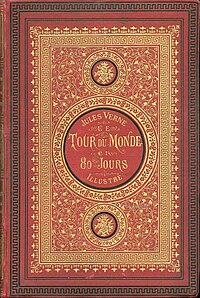
(first edition cover, courtesy of Wikipedia)
98. Verne, Jules. Around the World in 80 Days. 297 pages. 8.4.09.+

Around the World in 80 Days is the most recent book in the list of novels I have read to my son. Never having read Verne before I settled on our nightly routine, I found myself convinced that his novels would be good "boy books", and am pleased to say that I myself have found them very entertaining.

First published in 1873, Verne's narrative describing an eccentric gentleman's pursuit of a saloon wager is charming in its simple and straightforward presentation of what may be seen as typical 19th-century views and expectations. Although many of the stereotypes and presentations of British imperialism would be viewed as politically and socially incorrect to a modern audience, the innocence and casual frankness of Verne's depictions allow readers a glimpse at how the British may really have viewed their place in the global community. For this alone, I find the novel intriguing.

The characters of the novel are strangely underdeveloped, which allows the reader to focus more on the excitement of the journey as opposed to the emotional consequences suffered by the protagonists. Passepartout, Mr. Fogg's French valet, is arguably the most developed character, and proves to be an interesting addition as readers not only discover information about his rather colorful past, but are likewise pacified in the desire for emotion that is markedly absent from the figure of Phileas Fogg himself.

In the end, I enjoyed Around the World in 80 Days much more interesting than our reading of Journey to the Centre of the Earth, despite (or perhaps because of) its simplicity of plot and character. Verne's 1873 novel frequently appears on reading lists for young teenagers, and I strongly agree with the recommendation; I can't wait until Brooks has a chance to read it for himself.


99. Kenyon, Sherrilyn. Acheron. 816 pages. 8.4.09.

It's hard to give this book a fair rating. I enjoyed learning of Acheron's past, but for every interesting passage or chapter there is an equally dull or tedious one.

Wednesday, June 10, 2009


69. Austen, Jane. Northanger Abbey. 213 pages. 6.10.09.

Jane Austen's first novel is a delightful and witty satire of gothic literature, and is a paradigm of both her future genius and current youthful exuberance. While I would argue that Austen by no means condemns the genre itself nor the reading of it, she does artfully illustrate the foolishness of expecting such romantic extremes in real life, and in her own writing acknowledges the conventions of the genre that render it so identifiable. Like Austen's later work, Northanger Abbey is full of social commentary and astute observations as she leads you through a year of the life of Catherine Morland - the increasingly romantic young woman who finds herself in several less-than-gothic conflicts.

Northanger Abbey is as charming the second and third time as it was the first. As a fan of both Austen's body of work and the gothic genre, I can't help but find myself enamored with this particular work. I do not hesitate to give Northanger Abbey my highest rating.

Thursday, June 4, 2009


65. Twain, Mark. The Prince and the Pauper. 267 pages. 6.4.09. *

Poor little Tom Canty and Edward, Prince of Whales, could little expect what adventures would ensue the day they innocently exchanged clothes as a means of satisfying their boyish fancies. Each boy is confronted with trials and tribulations unlike anything they expected for their lives, and each grows and matures well, according to those lessons learned.

Mark Twain's tale of innocence and mistaken identity is completely charming, and his expertise as a master story-teller is confirmed with The Prince and the Pauper. Though the prose is simple enough to suit a wide range of readers, the narrative itself is colorful and elegant, and is a real treat for the imagination.

Tuesday, May 19, 2009


55. Orwell, George. 1984. 254 pages. 5.19.09.

1984 is one of those novels I have intended to read for years, and had never gotten around to. However, I finally managed to get to it, for better or for worse. Orwell's dystopian novel has left me feeling rather prosaic, and I'm not quite sure how to express my feelings regarding the text. In the simplest terms, I didn't like the novel; but I don't think I was supposed to. And I certainly don't regret taking the time to read it.

Monday, May 18, 2009

54. Lovecraft, H.P. "The Call of Cthulhu." 31 pages. 5.18.09.

"...all the earth would flame with a holocaust of ecstasy and freedom."

I have received numerous recommendations over the years for the work of horror legend H.P. Lovecraft, and have often been met with surprise when I admit that I had never read his work. While I am a horror and gothic enthusiast I always felt apprehensive about Lovecraft's work - after all, how could he possibly compare to such greats as Edgar Allen Poe and Sheridan Le Fanu?

Despite having the Tales of H.P. Lovecraft (edited by Joyce Carol Oates) sitting on my shelf, I decided to download Lovecraft's "The Call of Cthulhu" on my Kindle2 after seeing it mentioned in a group on LibraryThing. ( I apologize now, because I cannot for the life of me remember who brought it up recently, but it inspired me to give Lovecraft a try once and for all).

I am pleased to say that I was not disappointed. "The Call of Cthulhu" is a delightfully dark and twisted tale that has the ability to draw readers in from its first mysterious pages. The tale is presented from the point of view of a secondary source (the nephew and executor of a deceased professor) stumbling upon the research and first-person accounts regarding an ancient and malevolent entity by the name of "Cthulhu." As cult members practice dark arts in order to revive this creature from its watery depths, the narrator realizes with horror that it has already been done, and instills in readers a kind of apprehension that such a thing can be innocently done again, much to the detriment of all living creatures.

Lovecraft's style is at once elegant and non evasive, so his language adds to the understanding and delight of the reader as opposed to detracting from the story with superfluous prose. The evolution from nineteenth-century gothic literature is evident, which helps to ground the short story in a strong literary history, while allowing it to evolve into what audiences now call "horror."