Showing posts with label bed time story. Show all posts

Monday, August 16, 2010

65.
Author: Mark Twain
Title: The Adventures of Huckleberry Finn
Publication: Hardcover
Pages: 300 pages
Genre: Classics, bedtime stories
Acquisition: Max's book
Date Completed: August 16, 2010
Rating: 3 stars out of 5

Whew! Another tongue-twister of a bedtime story for my monsters. I feel out of breath just thinking of Jim's dialog, and my head is still reeling a little bit. I suppose Huck Finn is a classic for a reason, but I personally did not enjoy it nearly as much as I enjoyed reading the boys Tom Sawyer. Now I'll have to wait a few years to hear what they think.

Sunday, August 1, 2010

61.
Author: Neil Gaiman
Title: Odd and the Frost Giants
Publication: Hardback
Pages: 117 pages
Genre: Young adult, mythology, bedtime stories
Acquisition: Purchased for Brooks
Date Completed: August 1, 2010
Rating: 4 stars out of 5

The little Norse boy named Odd does everything with a smile on his face. Odd smiles when he's scolded, and doesn't lose the smile when he hears of his father's death. Odd smiles when he cripples his right leg and foot, and he smiles when he meets a trio of talking animals claiming to be gods. Odd even smiles when he comes face to face with a Frost Giant, and the giant threatens to crush him.

Odd and the Frost Giants is a delightful mock-epic in which Gaiman writes a crippled young boy into the world of the Norse gods. With little more than his (not so) simple understanding of human/god nature Odd conquers feats that leave the more-powerful themselves crippled, and with quiet perseverance he pursues a life more welcoming than the one in which he lives.

Despite Gaiman's never-ending love affair with comma splices, his young adult novel is quite charming. I would recommend it to young readers and parents alike.

Tuesday, February 16, 2010

17.
Author: Mark Twain
Title: The Adventures of Tom Sawyer
Publication: Barnes and Noble
Pages: 218 pages
Genre: Classic
Acquisition: Purchased for Brooks, Christmas 2009
Date Completed: February 16, 2010
Rating: 4 stars out of 5

Somewhere along the way I came up with the notion that I hated Mark Twain's novels. I read The Adventures of Huckleberry Finn for school at some point and, like so many other wonderful works assigned throughout the years, I instantly hated it.

However, not wanting my own prejudices influence the boys, I decided to pick up Tom Sawyer for Brooks for Christmas (and Huck Finn for Max). Tonight Brooks and I finished reading the novel, and I was pleasantly surprised.

Tom Sawyer is a fascinating look at nineteenth-century American boyhood. I found the characters compelling, and the narrative is perfect for bedtime reading (thanks to careful timing and purposeful chapter breaks). I thoroughly enjoyed the work, and look forward to picking up Huck Finn in the future.

Challenges
75-Book Challenge: Book 17
1010 Challenge: YA/Read to the boys Book 2
Off-the-shelf:

Friday, November 27, 2009


132. George, Jean Craighead. My Side of the Mountain. 177 pages. 11.26.09.

My Side of the Mountain is a young adult classic which chronicles a year in the life of Sam Gribbley. Sam leaves his overcrowded home in New York City to seek out the farmland of his ancestors, and learns to survive on the land in the company of a cast of wild creatures. My Side of the Mountain serves as a guidebook at times, as Sam informs his readers what plants are edible, how to make a bed, and how he manages to make leather for his deerskin suit. It is a charming story for young children.

As an adult reading the novel to my toddler I have one problem - comma splices. Oh, the comma splices! I am not a grammarian by any stretch of the imagination, but the errors in George's novel make it very difficult to read out loud.

Thursday, October 8, 2009

Thank you for all the well-wishes, everyone! Tomorrow is going to be an exciting day.


119. Armstrong, Kelley. [Frostbitten]. 339 pages. 10.5.09.

Fairly typical of Armstrong, but no less entertaining for it.


120. Verne, Jules. Twenty-Thousand Leagues Under the Sea. 279 pages. 10.8.09.*

A mysterious creature is haunting the seas, and Professor Aronnax is determined to discover the origins of the beast. However, the encounter brings more than he ever expected, as he is captured by the strange and withdrawn captain of a submarine ship and whirled around the world's oceans. The aquatic wonders he experiences thrill his academic soul, while the actions and motivations of his host leave him questioning both the individual and civilizations at large.

Verne's underwater adventure is the latest novel I have read to my toddler at bedtime, and is far from my favorite. As we finished the third Verne novel we have approached I found myself lamenting a brilliant story bogged down by careless prose; I found that the language was flat and uninspired, and the sentence structure was unbelievably choppy. The failings of the writing itself took away from what would otherwise have been a book full of wonders, and I believe we will leave Verne buried once and for all.

Tuesday, August 4, 2009


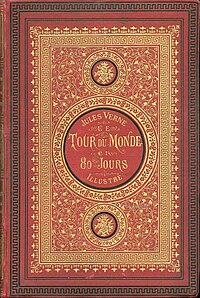
(first edition cover, courtesy of Wikipedia)
98. Verne, Jules. Around the World in 80 Days. 297 pages. 8.4.09.+

Around the World in 80 Days is the most recent book in the list of novels I have read to my son. Never having read Verne before I settled on our nightly routine, I found myself convinced that his novels would be good "boy books", and am pleased to say that I myself have found them very entertaining.

First published in 1873, Verne's narrative describing an eccentric gentleman's pursuit of a saloon wager is charming in its simple and straightforward presentation of what may be seen as typical 19th-century views and expectations. Although many of the stereotypes and presentations of British imperialism would be viewed as politically and socially incorrect to a modern audience, the innocence and casual frankness of Verne's depictions allow readers a glimpse at how the British may really have viewed their place in the global community. For this alone, I find the novel intriguing.

The characters of the novel are strangely underdeveloped, which allows the reader to focus more on the excitement of the journey as opposed to the emotional consequences suffered by the protagonists. Passepartout, Mr. Fogg's French valet, is arguably the most developed character, and proves to be an interesting addition as readers not only discover information about his rather colorful past, but are likewise pacified in the desire for emotion that is markedly absent from the figure of Phileas Fogg himself.

In the end, I enjoyed Around the World in 80 Days much more interesting than our reading of Journey to the Centre of the Earth, despite (or perhaps because of) its simplicity of plot and character. Verne's 1873 novel frequently appears on reading lists for young teenagers, and I strongly agree with the recommendation; I can't wait until Brooks has a chance to read it for himself.


99. Kenyon, Sherrilyn. Acheron. 816 pages. 8.4.09.

It's hard to give this book a fair rating. I enjoyed learning of Acheron's past, but for every interesting passage or chapter there is an equally dull or tedious one.

Thursday, June 4, 2009


65. Twain, Mark. The Prince and the Pauper. 267 pages. 6.4.09. *

Poor little Tom Canty and Edward, Prince of Whales, could little expect what adventures would ensue the day they innocently exchanged clothes as a means of satisfying their boyish fancies. Each boy is confronted with trials and tribulations unlike anything they expected for their lives, and each grows and matures well, according to those lessons learned.

Mark Twain's tale of innocence and mistaken identity is completely charming, and his expertise as a master story-teller is confirmed with The Prince and the Pauper. Though the prose is simple enough to suit a wide range of readers, the narrative itself is colorful and elegant, and is a real treat for the imagination.

Tuesday, March 24, 2009

29. Vern, Jules. Journey to the Centre of the Earth. 291 pages. 3.24.09. *

Verne's Journey to the Centre of the Earth was nothing like I expected. I have never read any Verne before, but I thought I was familiar with some of the basic ideas of the novel. However, this "popular" knowledge was largely erroneous, and the book turned out to be more academically interesting than entertaining in a common sense.

I expected Journey to the Centre of the Earth to be a more traditional adventure story, similar in tone and style to Treasure Island. Instead, the novel reads more like a 19th-century scientific travel narrative, focusing on internal struggles and academic achievements over physical catastrophes and encounters. The details I expected - those concerned with prehistoric life existing in the center of the earth - are only briefly described towards the end of the novel. In the space of a couple chapters Verne discusses these phenomena, before returning to the description of the journey at hand. As the title itself suggests, I found that the novel is actually concerned with the journey, as opposed to what may be discovered at its end.

I had no idea what I was getting myself into when I decided to read this novel to my son as his latest bedtime story. Many of the locations, names, and scientific terms threw me for a loop, and I found myself mumbling more than once. Luckily, my son is only one and didn't know the difference.

Monday, February 9, 2009

12. Stevenson, Robert Louis. Treasure Island. 303 pages. 2.4.09.*

Stevenson's classic treasure hunt is a story that will always be remembered in cultural history. Generations of readers can easily relate to Jim's adventures, and will find it easy to navigate through the narrative itself, despite evolving vocabulary, speech patterns, and usage. Full of charming characters such as Long John Silver and Jim Hawkins, adventure, treasure, pirates and intrigue, Treasure Island is a treat for all ages.

13. Sophocles. Oedipus Rex. 37 pages. 2.9.09.+

Rereading - and teaching - Oedipus Rex as an adult was an interesting experience. While I am always a bit wary of translations, the text itself (as translated by Robert Fitzgerald) is rich with literary devices, and the use of foreshadowing is especially poignant. Sophocles adeptly leads his audience through a series of emotions, guiding responses and perceptions with ease. One characteristic of the play that I found most thought-provoking was the removal of violence. While I'm sure this was done in part to accommodate the logistics of the ancient Greek stage (how would you show someone hanging, for example), I can't help but feel it was also done in order to allow the audience to focus on the emotionally-charged consequences as opposed to the gore that is Oedipus' fate. A wonderful work.