Showing posts with label nineteenth-century. Show all posts

Saturday, May 7, 2016

As I prepare for my final term paper I realized that I hadn't yet posted some of my independent study readings.

39.
Title: [The Woman in White]
Author: Wilkie Collins
Genre: Victorian Gothic
Medium: Broadview Paperback
Acquisition: Victorian IS Reading
Date Completed: Spring 2016
Rating: ******

Wilkie Collins' The Woman in White is a wonderfully gothic sensation novel, rich in themes of morality, madness, deceit, and romance. Walter Hartright (heart - right) is engaged as a drawing instructor in a wealthy country household, and, predictably, falls in love with the beautiful sister, Laura.  Thematically consistent is Laura's standing engagement to the reprehensible Sir Percival Glyde, to whom Laura promises herself at her father's deathbed, and to whom she is married in the early course of the novel.  Glyde is not what he appears to be, and his repugnant characteristics reveal themselves as a mysterious young woman, Anne, makes herself known as a one-time childhood companion of Laura, devotee to Laura's late mother, and keeper of a secret that threatens Glyde in some mysterious way.  Though many of these narrative devices and themes are consistent within the genre, to the point of near-cliche, Collins masterfully builds mystery and suspense, serving his readers both what they expect of the material, while using strong characterization to heighten the reader's engagement with the narrative.  The reader will shrink from Glyde, mistrusting his actions, and feeling anxiety over Laura; though traditionally pathetic, Laura's strong character allows for a level of sympathy occasionally denied heroines her her position; Count and Countess Fosco are perhaps even less trustworthy than their friend and host, Gylde, and loom ominously around the edges of the narrative, and so forth.  That the romantic lead Walter is a shallow wash of a character does not hinder the plot, but rather allows for the substitution of one's own romantic figure in his place, allowing a personal entry into the narrative for maximum fantasizing.

For my own purposes and writing, Anne is the most engaging character, and her relationship to Laura provides a point of fascination.  The titular "woman in white," Anne is both phantom and fleshly, represented as slightly mad and therefore less trustworthy, but a keeper of some of the most extraordinary knowledge in the novel.  In reading the material construction of identity, I am struck by the other characters' reading of her blanched wardrobe, and its purported significance, not so far from a time when such choices would be fashionable and romantic.  Significant, too, is her status as a doppelganger, and the machinations surrounding this pot device.  I find it difficult to go further without spoiling the mystery of the novel, but promise to make good use of these points in my final semester writing.

Highly recommended for fans of the Victorian or the Gothic.

40.
Title: [The Odd Women]
Author: George Gissing
Genre: Victorian
Medium: Broadview Paperback
Acquisition: Victorian IS Reading
Date Completed: Spring 2016
Rating: ****

The position of women in nineteenth-century England cannot be over-exaggerated: they are victimized at every level of society, and have to fight extraordinary social and political battles to attain even the most basic rights. Gissing's The Odd Women works to illustrate society's failure in relation to unmarried women specifically, Gissing's "odd" women being the "redundant" women of Rathbone's lamentation.  The novel opens with the orphaning of the Madden sisters, daughters of a physician of various ages and levels of education, none of whom are prepared for self-support.  When Dr. Madden's untimely demise leaves the girls to fend for themselves they, as a rule, fail, and the novel follows the regrettable existence of half of these daughters, along with their bluestocking friend, Rhoda.  The text works hard to reveal social ills, and to illustrate the efforts being made to rectify these shortcomings.  Critically, Gissing's work feels extraordinary, and is a significant critique that belongs on any introductory English or gender studies syllabus.  Personally, I did not enjoy the text; the Madden sisters in their poor state are wooden ad monochromatically pathetic, and so while I lament greatly their position my emotional response comes wholly from my own historical research rather than the narration of the sisters themselves.  Similarly, I found Rhoda to be exceptionally abrasiveness, and while I enjoy her position, and can laugh at some of her extremist views, I found her to be ineffective for my own current position. Final thoughts: important and useful social text, but not necessarily an engaging personal read.

Friday, May 6, 2016

36.
Title: [The Maiden Tribute of Modern Babylon]
Author: William Thomas Stead
Genre: Journalism, History, Victorian
Medium: Paperback
Acquisition: Victorian IS Reading
Date Completed: May 5, 2016
Rating: *****

In 1885, dissatisfied with the lack of protection afforded minors by the law, William Thomas Stead published a four-part work of investigative journalism, exposing the insidious world of child prostitution in London, and specifically the thriving market for virgins supplied through coercion, deceit, and frequently rape.  Often posing as a gentlemen in the market for a "maiden," Stead meets with brothel owners and introducers, follows the mistresses and their charges to midwives and doctors for certificates of virginity, and even manages private conversations with girls during which he tries, often unsuccessfully, to more fully explain their situations. Time and time again Stead secures the sale of these young women, for £5, £7, £10 pounds, and hears of patrons who brag of requiring so many virgins a fortnight, or having "ruined" over 3,000 girls in the course of his sexual career. As a body, and with no exception in his writing, Stead views these children and young women as victims of a malicious system that is unchecked by law and instead protected by a judicial system which favors the wealthy men who are its clientele. At a time when a child of thirteen can consent to sexual acts, despite her more common ignorance of sex , the law wholly protects the men who participate in what Stead calls "organized rape" (9). Even when raped, the victims of this industry have no recourse: "No one will believe for story, for when a woman is outraged,by fraud or force, her sworn testimony weighs nothing against the lightest word of the man who perpetrated the crimes" (34).

Stead's publications is both fascinating and heartbreaking. He exposes the machinations of the industry, and brings to light the various methods "introducers" and procuresses use to harvest young women for the commodity of their virginity, most often manipulating them into an arrangement which leaves the young girls ignorant of events to come, and later traps them in a web of prostitution from which very few are ever able to escape. Personal narratives humanize the subject, balancing Stead's observations with purportedly true accounts of women trapped in the industry, at times outright kidnapped, and even sold abroad to European and American brothels. The legal, gendered, and sexual problems that allow for the commercial system Stead so aptly vilifies are far from resolved; though the legal age of consent was eventually raised in the UK, child sexploitation and human trafficking persist, often relying on the same commodification of the young, often female, body, and a gendered system of dominance and abuse.  In this way, Stead's accounts are timeless, and serve as a strong historical primary source to understand a bit of a continually contemporary horror.


35.
Title: Student Papers
Length: Over 300 pages
Date Completed: May 3, 2016

Sunday, April 17, 2016

29.
Title: [Beowulf]
Author: Trans. Seamus Heaney
Genre: Anglo-Saxon Poetry
Medium: Paperback
Acquisition: Teaching Text
Date Completed: April 14, 2016
Rating: *****

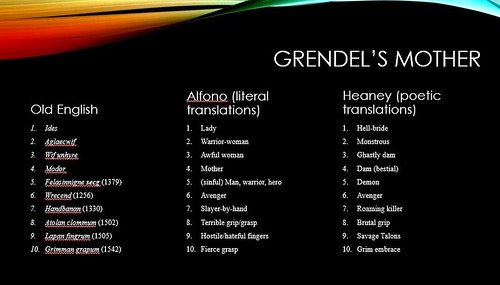
This semester I had a few students who objected to my use of the term "cannibalism" to describe Grendel's transgressions, and my admittedly tongue-in-cheek description of Beowulf's fight with the infamous man-eater. After a day of interesting debate I used our disagreement as an opportunity to more explicitly discuss the problems of translation, as we had briefly addressed in our readings of Sappho and Dante.  In my writing on Grendel's mother for a conference in 2014 I came upon an article by Christine Alfono, who directly addresses the inherent bias in Anglo-Saxon translation, specifically as it relates to Grendel's mother and her characterization in the translated poem.  As an illustration, I shared with my student's Alfono's offering of five different translations - and their connotations - from the same Anglo-Saxon line, and I further complied a list of ten terms named by Alfono, what she asserts are "literal" translations of the words (a few I confirmed online, for my own curiosity), and Heaney's word choices.

Grendels mother slide

Though I will agree to disagree with my students on our initial difference of understanding, the lecture served its purpose, and we had another lively discussion about why some translations may make sense, and how others belie the cultural prejudices named by Alfono in her own scholarship.


It's been an odd semester, engaged in two separate independent studies.  Left to my own devices for one, I found myself reading most of each week's novel before rushing off to the next at the rather frenzied pace I had set for myself.  Now I'm finding the time to get to the last few chapters of each as I prepare to write about them all. My reviews here are brief, because I am reserving more specific thoughts and readings for the essay I am preparing.

30.
Title: [Lady Audley's Secret]
Author: Elizabeth Braddon
Genre: Victorian Sensational FIction
Medium: Broadview Paperback
Acquisition: IS Primary Source
Date Completed: April 17, 2016
Rating: *****

Elizabeth Bradden's sensational 1862 novel was, according to the Broadview edition, "one of the most widely read novels in the Victorian period," and it's certainly clear why. Full of mystery, blackmail, bigamy, and other foul crimes, the text navigates social and gendered spheres with a rapidity that leaves the reader's head spinning with excitement as she follows the lay-about nephew of Sir Audley as he seeks out the truth of his friend's disappearance, and the secrets kept by his childish, doll-like aunt, Lady Audley.  The novel exchanges on the Victorian love of mystery and armchair detection, and offers a series of puzzles sure to delight original and contemporary readers.

The back of the Broadview edition further asserts that the novel "creates significant sympathy for the heroine, despite her criminal acts, as she suffers from the injustices of the 'marriage market' and rebels against them." My own reading contradicts this analysis, at least in the first. On the contrary, I found Lady Audley to be repugnant. Early in her life Lady Audley is treated very poorly, and her personal narrative seeks to emphasize the injustices of the gendered systems of nineteenth-century England. She is legitimately a victim a this point, and all sympathy belongs to her, blame falling squarely on the shoulders of he who mistreats her. However, her true character is revealed in how she seeks to improve her conditions, ultimately dissuading the reader from the sympathy Broadview suggests. There is a line of desperation and innocence Bradden could have maintained in order to shift blame and sympathy, but she crosses this.  The final explanations serve as a convenient and absurd excuse by a conniving criminal, and the triviality of her actions keep her from becoming even an engaging villain.  I am disappointed in Lady Audley, who I was very prepared to adore for her passionate grasping of autonomy and assertion of self, but I found her wanting.

As a whole, I thoroughly enjoyed the book, and found much to write about - so much, in fact, that my difficulty is now in limiting my options.


31.
Title: [North and South]
Author: Elizabeth Gaskell
Genre: Victorian FIction
Medium: Penguin Paperback
Acquisition: IS Primary Source
Date Completed: April 17, 2016
Rating: ***

For all my disappointment in Lady Audley, however, she remains far more engaging and interesting as a character than Margaret Hale, of Elizabeth Gaskell's 1855 North and South.  Upon the marriage of her cousin, Margaret Hale leaves the London house of her aunt, where she had been residing, to return to the utopia of her childhood home, of which she waxes eloquently to all who will hear for much of the early portions of the novel.  Unfortunately, this peace is broken by her father's crisis of conscience, and when he gives up his parish post he moves Margaret and her mother with him to a Northern industrial city, where they are forced to take dingy accommodations, breathe polluted air, and lament the lack of society in the city where Mr. Hale has elected to become a private tutor.  North and South ruminates on the deplorable living and working conditions of the lower-class employees of mills, as Margaret Hale tries to find her own place in Milton.  While the social commentary is thoughtful, and provides a useful perspective in understanding the use and function of the Victorian novel in the popular understanding of such divides and social reform, I could not maintain interest in the protagonist, who is ultimately too perfect to be compelling. I personally prefer characters with texture - or perhaps deviance -but even her transgressions are perfectly situated to emphasize her goodness and adherence to the expectations of proper nineteenth-century middle-class women.  Ultimately I was fairly horrified by the connotations of the conclusion of the romantic plot, which I assert promises only misery for Margaret.  

Monday, April 11, 2016

27.
Title: The Nigger's Opera; or, The Darkie That Walked in Her Sleep and accompanying historical context in Broadview edition
Author: William Brough, for Christy's Minstrels
Genre: Drama
Medium: [The Broadview Anthology of Nineteenth-Century British Performance], ed. Tracy C. Davis
Acquisition: IS Primary Source
Date Completed: April 9, 2016
Rating: ***

With such an inflammatory title, Brough's The Nigger's Opera requires historical context, though even Davis' thoughtful work cannot dissipate the discomfort of either title or theatrical rhetoric.  Thoroughly fascinated by "the primitive other," Victorians have a history of appropriation and exploitation both, which they pursue under the guise of their racial and cultural superiority, and with the assumption that they are benign benefactor's whose mission, as a people chosen by God, is to civilize the world in their own moral image.  Of course, the actual practice of these morals is questionable, but that's a different subject for discourse. Here, it is relevant to introduce the subject of the "minstrel," or native musical performances such the British found "pleasing yet 'primitive'" (265).  According to Davis, the minstrel performances at Christy's, which introduced actors and actresses in evening clothes and blackface, parodying more serious works of the day, were viewed as wholesome and appropriate entertainment for families; she quotes a February 1862 Morning Chronicle which asserts that the musical performances "are utterly devoid of coarseness or vulgarity, and would not be out of place even in the drawing-room of the most fastidious." Davis further describes the cultural response to this phenomenon when she asserts that "In England, blackface impersonators alluded to a distance culture, separated from English rule for several generations, preserving practices rejected by British law in 1833 and detested long before. ... in Britain Christy's specific brand of it was scrupulously decorous family fare" (266).  Questions of content, representation without passing, costuming and makeup, and a whole host of other artistic and cultural influences speak to a modern understanding of the phenomenon, which Davis well presents to readers.

The content of Brough's actual work is as shallow as one might expect. The footnotes relate that this is a "Burlesque of La sonnambula composed by Vincenzo Bellini," and further connect the plot to the original in subsequent annotations. At the heart of the story is a trivial misunderstanding worthy of a Shakespearean romance: Dinah, the principal, is about to be married, but her suitor rejects her after finding the young woman in the rooms of Dolphus, "a heavy swell of color according to his own account a count being empowered by Royal Italian Opera license to change his name to Rodopho." There are significant literary allusions made, such as Jim' statement "I could act Othello's part!" (297), songs sung, and an easy resolution found when Dolphus and Jim together see Dinah sleepwalking, explaining her previous actions (and the title of the play). Not unlike my recent reading of Moore, I did not enjoy Brough's plays. However, I am glad for their inclusion in this anthology to extend my awareness and understanding of theatre in the nineteenth-century, particularly of a genre that I assumed was wholly American.


28.
Title: The Gypsy Maid
Author: William Brough, for Christy's Minstrels
Genre: Drama
Medium: [The Broadview Anthology of Nineteenth-Century British Performance], ed. Tracy C. Davis
Acquisition: IS Primary Source
Date Completed: April 10, 2016
Rating: ***

The Gypsy Maid is Burough's burlesque of The Bohemian Girl by Michael William Balfe, and trades on word play to examine race, class, performance and identity. A Count's daughter disappears, for whom he weeps for twelve years before her miraculous reappearance as a gypsy maid (another subjugated class, as Davis says on page 313 that "Until 1856, Gypsies were enslaved in what is now Romania"), and marriage to a "swell" who disguises himself as a gypsy. The plot is even less satisfying than the previous, but offers more intriguing representations of social demarcations and boundaries that speak both to the specifics of the plot and the more general of nineteenth century British life.

Tuesday, January 26, 2016

7.
Title: [Manhood in America: A Cultural History]
Author: Michael Kimmel
Genre: Masculinity
Medium: Paperback
Acquisition: Masculinity IS Book 1
Date Completed: January 22, 2016
Rating: ***


In the introduction to Manhood in America: A Cultural Study, Michael Kimmel outlines the work of his book as seeking “how the definition of masculinity has changed over time” and how those definitions and experiences have “shaped the activities of American men” (1).  He admittedly focuses on the definitions and assertions of “straight white men” as “the dominant version” of manhood in order to forward an understanding of just one of many masculinities (4-5).  In this way, Kimmel’s book is a broad, informative, and flawed text, articulating the historical anxiety of dominant white male masculinity without nuance or great insight. Kimmel’s research is both extensive and limited – he well-documents masculine definitions and demonstrations from significant and varied primary sources, but with an eye towards the extreme expostulations and anecdotal that (I believe) ultimately detract from his ethos.  The project seeks to generate a history of dominant American manhood, and does so by moving between historical periods, and finding the “real men” in each period’s cultural artifacts.


8.
Title: [Lady Susan]
Author: Jane Austen
Genre: Nineteenth Century
Medium: Paperback
Acquisition: Victorian IS Book 2
Date Completed: January 25, 2016
Rating: *****

Lady Susan is a manuscript work from Jane Austen, published posthumously by her family. A short epistolary novel, Lady Susan follows the actions (and reprisals) of the titular character, who becomes a widow just before the novel's opening, and is unapologetically and thoroughly a Flirt, much to the approbation of society and family, save the approval of one friend.

Lady Susan's letters to her dear friend Alicia fully demonstrate her true character, as much as her letters to family and suitors demonstrate her dedication to social manipulation.  Lady Susan, and Alicia, not only accept the label of "Flirt," but revel in it, and glory in their ability to influence, gain hearts, and destroy proposals.  Lady Susan woos men not for true interest, but because she believes she should be adored, and figuratively collects the hearts of her lovers not unlike Margaret of Valois.

The novel clearly tries to present Lady Susan as repugnant for her social faux pas and her maternal failings, but I think there's something more to be said about a woman of her confidence and beauty, in the time and society in which she's found. It's a delightful romp, and certainly one for any who enjoy Austen.  

Sunday, June 12, 2011

49.
Author(s): Kathryn Hughes
Title: The Victorian Governess
Publication: Hardback
Pages: 204
Genre: Nonfiction, History, 19th-century
Acquisition: Purchased used from Abe Books
Date Completed: June 12, 2011
Rating: ****1/2

The history of the Victorian governess is a difficult one to write for one very basic reason: a lack of reliable primary source material. Though historians have access to some government and institutional data, and a clutch of letters, magazines, and a few precious journals, the gaps these sources have left remain far more significant than the enlightenment they can provide.

Fiction will tell us that the governess plays an essential role in the lives of upper-middle-class and upper-class households, but what of the real women who toil away in isolated schoolrooms? While some "histories" of the profession feel justified in using fiction as fact in the absence of actual historical documentation, Hughes attempts to construct a history of the governess that is as grounded in reality as possible. Her examination does indeed discuss fictional governesses - in the first chapter, after which her allusions to novels are kept to a minimum. Instead, Hughes relies on what documentation is available, and focuses on the lives of a few known governesses, and the popular publications which discussed the "plight of the governess" during the nineteenth-century, in order to piece together as accurate an analysis as possible.

Hughes' account fully acknowledges the gaps that are inherent in such a project, but uses this absence of information to make a few significant observations about the role of the governess in Victorian society. The volume as a whole is concise and smart, and makes good use of the resources at hand. Overall, I found The Victorian Governess far preferable to Ruth Brandon's Governess: The Lives and Times of the Real Jane Eyres.