Showing posts with label Victorian. Show all posts

Monday, September 26, 2016

81.
Title: [Catwoman: Selina's Big Score]
Author: Darwyn Cooke
Genre: Comic
Medium: Paperback
Acquisition: Library Book
Date Completed: September 20, 2016
Rating: ***1/2

A re-read, with some interesting history

82.
Title: [Catwoman: Vol. 1 the Game]
Author: Judd Winick
Genre: Comic
Medium: Paperback
Acquisition: Library Book
Date Completed: September 21, 2016
Rating: ***

Another reread.

83.
Title: [Victorian Fashion]
Author: Jayne Shrimpton
Genre: Fashion History
Medium: Paperback
Acquisition: Library Book
Date Completed: September 23, 2016
Rating: ***

Jayne Shrimpton's slim volume is a brief introduction to the forms and functions of fashion; its greatest value is that it does not limit its object of study to women's fashion, as is common, but rather extends her subject to men and children as well. Some interesting trivia is included for the more-familiar, such as the inspiration for men's facial hair, and the origins of the term "crinoline," but the text is more greatly geared towards the curious but uninformed. While it does not suit my current purposes, it is a charming little book.

84.
Title: [Victoriana]
Author: James Laver
Genre: Material Culture, History
Medium: Hardback
Acquisition: Library Book
Date Completed: September 25, 2016
Rating: ***

James Laver’s Victoriana is a companion history for aspiring collectors of Victorian kitsch, broadly identifying artistic movements and points of taste. The content of the book is a glossing of material culture, more useful for its illustrative presumptions and suppositions, often reading objects at face value (such as fashion plates representing “real” life) and thereby articulating cultural beliefs that may run contrary to the lived experiences of even the Victorian middle class.  Much of this use value is expressed in Laver’s introduction, which both defines “Victoriana,” and offers such keen insights as “the collapse of Victorianism …[and] the end of the Patriarchal System” thanks to the “New Woman” (25), and “the result [of the emancipation of the servant class is] that all women are now back at the kitchen sink” (25). That these two statements occur in parallel paragraphs speaks pretty greatly to the cultural moment of the 1960s, and undoes the argument that Victorianism and the Patriarchal system have collapsed.

Sunday, July 10, 2016


59-60.
Title: [Lost Girls: Volume 1] and [Lost Girls: Volume 2]
Author: Alan Moore
Genre: Graphic Novel
Medium: Hardback
Acquisition: Borrowed from Diss Adviser
Date Completed: June 16-17, 2016
Rating: ****

Alan Moore's three-volume Lost Girls is a pornographic re-visitation of three familiar fairytale characters meeting, and enjoying clandestine affairs, in an unusual hotel.  Alice (of Wonderland) is a wealthy elderly lesbian who has been socially shunned from her family - not that she cares much; Wendy (Darling) is a meek and submissive wife still daydreaming of dalliances in the park with a fairy-like young man; Dorthy is a spunky American Westerner spinning yarns of frisky farm life for her European companions. Together, the women share their sexually deviant but fulfilling histories, while enjoying a casual intimacy which is represented as comfortable and engaging, asking nothing and giving everything: the stories known to us as children are represented as metaphors for sexual awakenings and adventures in a very adult world. Realistically, there are some power dynamics which show a tendency towards predatory consumption of  young women, and taboos are unapologetically represented as part of the characters histories. In the telling, though, Moore gives each of the characters agency, allowing them the pursuit of pleasure and interesting a way that would have been (and arguable still can be) denied young women, and negates any sense of shame or apology. In a first reading I'd then suggest that this is an intriguingly feminist text, at once acknowledging how society and social groups can take advantage of young women, and how those same young omen can find their own autonomy in the ownership of their sexuality. Moore's take on these traditional female figures captures and articulates the strange in-betweeness of Victorian sexuality - that which shouldn't be, but is undeniably there. It also expresses a keen understanding of intended audience and fairy tales, giving back to adults a space of fantasy and metaphor that the Victorians relinquished to children. The series was recommended to me by one of my dissertation advisers as I first approached a project on gender and Victorian novels and modern comics, and it's something to think about as I move forward with the project.

61.
Title: [The Female Detective]
Author: Andrew Forrester
Genre: Detective Novel
Medium: Paperback
Acquisition: Beach Read
Date Completed: July 5, 2016
Rating: ***

Andrew Forrester's The Female Detective, published in 1864, is the first of its kind*, introducing a female protagonist in a relatively new genre. Using the name of Mrs. Gladden, although never actually recognizing this as her legal name, the female detective in question introduces the occupation to her readers in a series of narratives, both justifying her position and actions and relating the specifics of a series of "cases" in which she is involved.  As a whole, the novel is clumsy and unsure of itself, using bracketed asides and footnotes to try to direct and clarify and generally justify the text, characters, and occupation itself. Interestingly, a true organization of occupation familiar to modern readers (and anyone familiar with police procedurals!) is missing, and Mrs. G reads more like a busybody with police connections than a competent professional; for example, in one significant case she takes it upon herself to research the strange adoption of a young girl, whose household presence secures a financial legacy, ultimately revealing the results of her investigation because it is "required" of her position, though she was hired of no one and her investigation threatens to bring true harm to very good people. Her works seems more like that of cozy mystery protagonists than a professional detective, which has interesting gender implications for the genre itself.  Not good in its own right, Forrester's novel is nonetheless an interesting cultural object for the study of Victorian culture, and the evolution of the genre.

*Like many "firsts", this is a bit contentious. However, despite the existence of Ruth the Betrayer from 1862/3, I'll maintain for my own purposes that Forrester's novel is "first." My own personal justification for this is that Ellis' text is a serial penny dreadful, a different form of publication from Forrester's formal novel publication.  Therefore, Ellis' spy may be the first female detective in English, but Forrester's novel is the first female detective novel.

62.
Title: [Clean Room]
Author: Gail Simone
Genre: Graphic Novel
Medium: Paperback
Acquisition: Pre-ordered
Date Completed: July 6, 2016
Rating: *****

A well-written, strongly-illustrated, highly-compelling graphic novel. Clean Room takes a Scientology-esque institution and places it into productive action, revealing an alternative awareness of the world which both enlightens and terrifies those who know. Astrid Mueller is a horror writer turned self-help guru who has attracted a large umber of devoted followers, including nearly all of Hollywood, who attend weekly "readings" and espouse her wisdom. The organization is also cited in a number of suicides, calling into question Mueller's intentions and control, and whether or not her "help" is really positive. When a reporter's fiance falls under Mueller's spell, and kills himself suddenly, she makes it her mission to expose Mueller and take down the organization. Of course, there is far more to the story than she imagines, which she discovers after being allowed a rare glimpse into the "clean room" that is Astrid's true command center. The book is a creative take on alternative social communities and suggestive of a real horror that will leave readers on edge.  The character development is strong and largely believable, making the fantastic all the more possible.  Very well done.

Saturday, May 7, 2016

As I prepare for my final term paper I realized that I hadn't yet posted some of my independent study readings.

39.
Title: [The Woman in White]
Author: Wilkie Collins
Genre: Victorian Gothic
Medium: Broadview Paperback
Acquisition: Victorian IS Reading
Date Completed: Spring 2016
Rating: ******

Wilkie Collins' The Woman in White is a wonderfully gothic sensation novel, rich in themes of morality, madness, deceit, and romance. Walter Hartright (heart - right) is engaged as a drawing instructor in a wealthy country household, and, predictably, falls in love with the beautiful sister, Laura.  Thematically consistent is Laura's standing engagement to the reprehensible Sir Percival Glyde, to whom Laura promises herself at her father's deathbed, and to whom she is married in the early course of the novel.  Glyde is not what he appears to be, and his repugnant characteristics reveal themselves as a mysterious young woman, Anne, makes herself known as a one-time childhood companion of Laura, devotee to Laura's late mother, and keeper of a secret that threatens Glyde in some mysterious way.  Though many of these narrative devices and themes are consistent within the genre, to the point of near-cliche, Collins masterfully builds mystery and suspense, serving his readers both what they expect of the material, while using strong characterization to heighten the reader's engagement with the narrative.  The reader will shrink from Glyde, mistrusting his actions, and feeling anxiety over Laura; though traditionally pathetic, Laura's strong character allows for a level of sympathy occasionally denied heroines her her position; Count and Countess Fosco are perhaps even less trustworthy than their friend and host, Gylde, and loom ominously around the edges of the narrative, and so forth.  That the romantic lead Walter is a shallow wash of a character does not hinder the plot, but rather allows for the substitution of one's own romantic figure in his place, allowing a personal entry into the narrative for maximum fantasizing.

For my own purposes and writing, Anne is the most engaging character, and her relationship to Laura provides a point of fascination.  The titular "woman in white," Anne is both phantom and fleshly, represented as slightly mad and therefore less trustworthy, but a keeper of some of the most extraordinary knowledge in the novel.  In reading the material construction of identity, I am struck by the other characters' reading of her blanched wardrobe, and its purported significance, not so far from a time when such choices would be fashionable and romantic.  Significant, too, is her status as a doppelganger, and the machinations surrounding this pot device.  I find it difficult to go further without spoiling the mystery of the novel, but promise to make good use of these points in my final semester writing.

Highly recommended for fans of the Victorian or the Gothic.

40.
Title: [The Odd Women]
Author: George Gissing
Genre: Victorian
Medium: Broadview Paperback
Acquisition: Victorian IS Reading
Date Completed: Spring 2016
Rating: ****

The position of women in nineteenth-century England cannot be over-exaggerated: they are victimized at every level of society, and have to fight extraordinary social and political battles to attain even the most basic rights. Gissing's The Odd Women works to illustrate society's failure in relation to unmarried women specifically, Gissing's "odd" women being the "redundant" women of Rathbone's lamentation.  The novel opens with the orphaning of the Madden sisters, daughters of a physician of various ages and levels of education, none of whom are prepared for self-support.  When Dr. Madden's untimely demise leaves the girls to fend for themselves they, as a rule, fail, and the novel follows the regrettable existence of half of these daughters, along with their bluestocking friend, Rhoda.  The text works hard to reveal social ills, and to illustrate the efforts being made to rectify these shortcomings.  Critically, Gissing's work feels extraordinary, and is a significant critique that belongs on any introductory English or gender studies syllabus.  Personally, I did not enjoy the text; the Madden sisters in their poor state are wooden ad monochromatically pathetic, and so while I lament greatly their position my emotional response comes wholly from my own historical research rather than the narration of the sisters themselves.  Similarly, I found Rhoda to be exceptionally abrasiveness, and while I enjoy her position, and can laugh at some of her extremist views, I found her to be ineffective for my own current position. Final thoughts: important and useful social text, but not necessarily an engaging personal read.

Friday, May 6, 2016

36.
Title: [The Maiden Tribute of Modern Babylon]
Author: William Thomas Stead
Genre: Journalism, History, Victorian
Medium: Paperback
Acquisition: Victorian IS Reading
Date Completed: May 5, 2016
Rating: *****

In 1885, dissatisfied with the lack of protection afforded minors by the law, William Thomas Stead published a four-part work of investigative journalism, exposing the insidious world of child prostitution in London, and specifically the thriving market for virgins supplied through coercion, deceit, and frequently rape.  Often posing as a gentlemen in the market for a "maiden," Stead meets with brothel owners and introducers, follows the mistresses and their charges to midwives and doctors for certificates of virginity, and even manages private conversations with girls during which he tries, often unsuccessfully, to more fully explain their situations. Time and time again Stead secures the sale of these young women, for £5, £7, £10 pounds, and hears of patrons who brag of requiring so many virgins a fortnight, or having "ruined" over 3,000 girls in the course of his sexual career. As a body, and with no exception in his writing, Stead views these children and young women as victims of a malicious system that is unchecked by law and instead protected by a judicial system which favors the wealthy men who are its clientele. At a time when a child of thirteen can consent to sexual acts, despite her more common ignorance of sex , the law wholly protects the men who participate in what Stead calls "organized rape" (9). Even when raped, the victims of this industry have no recourse: "No one will believe for story, for when a woman is outraged,by fraud or force, her sworn testimony weighs nothing against the lightest word of the man who perpetrated the crimes" (34).

Stead's publications is both fascinating and heartbreaking. He exposes the machinations of the industry, and brings to light the various methods "introducers" and procuresses use to harvest young women for the commodity of their virginity, most often manipulating them into an arrangement which leaves the young girls ignorant of events to come, and later traps them in a web of prostitution from which very few are ever able to escape. Personal narratives humanize the subject, balancing Stead's observations with purportedly true accounts of women trapped in the industry, at times outright kidnapped, and even sold abroad to European and American brothels. The legal, gendered, and sexual problems that allow for the commercial system Stead so aptly vilifies are far from resolved; though the legal age of consent was eventually raised in the UK, child sexploitation and human trafficking persist, often relying on the same commodification of the young, often female, body, and a gendered system of dominance and abuse.  In this way, Stead's accounts are timeless, and serve as a strong historical primary source to understand a bit of a continually contemporary horror.


35.
Title: Student Papers
Length: Over 300 pages
Date Completed: May 3, 2016

Sunday, April 17, 2016

29.
Title: [Beowulf]
Author: Trans. Seamus Heaney
Genre: Anglo-Saxon Poetry
Medium: Paperback
Acquisition: Teaching Text
Date Completed: April 14, 2016
Rating: *****

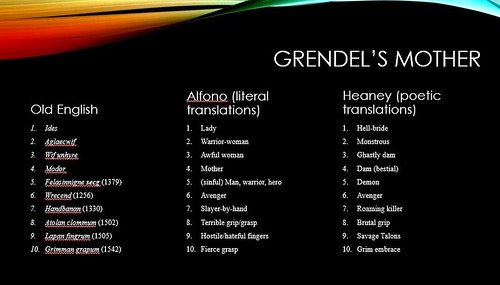
This semester I had a few students who objected to my use of the term "cannibalism" to describe Grendel's transgressions, and my admittedly tongue-in-cheek description of Beowulf's fight with the infamous man-eater. After a day of interesting debate I used our disagreement as an opportunity to more explicitly discuss the problems of translation, as we had briefly addressed in our readings of Sappho and Dante.  In my writing on Grendel's mother for a conference in 2014 I came upon an article by Christine Alfono, who directly addresses the inherent bias in Anglo-Saxon translation, specifically as it relates to Grendel's mother and her characterization in the translated poem.  As an illustration, I shared with my student's Alfono's offering of five different translations - and their connotations - from the same Anglo-Saxon line, and I further complied a list of ten terms named by Alfono, what she asserts are "literal" translations of the words (a few I confirmed online, for my own curiosity), and Heaney's word choices.

Grendels mother slide

Though I will agree to disagree with my students on our initial difference of understanding, the lecture served its purpose, and we had another lively discussion about why some translations may make sense, and how others belie the cultural prejudices named by Alfono in her own scholarship.


It's been an odd semester, engaged in two separate independent studies.  Left to my own devices for one, I found myself reading most of each week's novel before rushing off to the next at the rather frenzied pace I had set for myself.  Now I'm finding the time to get to the last few chapters of each as I prepare to write about them all. My reviews here are brief, because I am reserving more specific thoughts and readings for the essay I am preparing.

30.
Title: [Lady Audley's Secret]
Author: Elizabeth Braddon
Genre: Victorian Sensational FIction
Medium: Broadview Paperback
Acquisition: IS Primary Source
Date Completed: April 17, 2016
Rating: *****

Elizabeth Bradden's sensational 1862 novel was, according to the Broadview edition, "one of the most widely read novels in the Victorian period," and it's certainly clear why. Full of mystery, blackmail, bigamy, and other foul crimes, the text navigates social and gendered spheres with a rapidity that leaves the reader's head spinning with excitement as she follows the lay-about nephew of Sir Audley as he seeks out the truth of his friend's disappearance, and the secrets kept by his childish, doll-like aunt, Lady Audley.  The novel exchanges on the Victorian love of mystery and armchair detection, and offers a series of puzzles sure to delight original and contemporary readers.

The back of the Broadview edition further asserts that the novel "creates significant sympathy for the heroine, despite her criminal acts, as she suffers from the injustices of the 'marriage market' and rebels against them." My own reading contradicts this analysis, at least in the first. On the contrary, I found Lady Audley to be repugnant. Early in her life Lady Audley is treated very poorly, and her personal narrative seeks to emphasize the injustices of the gendered systems of nineteenth-century England. She is legitimately a victim a this point, and all sympathy belongs to her, blame falling squarely on the shoulders of he who mistreats her. However, her true character is revealed in how she seeks to improve her conditions, ultimately dissuading the reader from the sympathy Broadview suggests. There is a line of desperation and innocence Bradden could have maintained in order to shift blame and sympathy, but she crosses this.  The final explanations serve as a convenient and absurd excuse by a conniving criminal, and the triviality of her actions keep her from becoming even an engaging villain.  I am disappointed in Lady Audley, who I was very prepared to adore for her passionate grasping of autonomy and assertion of self, but I found her wanting.

As a whole, I thoroughly enjoyed the book, and found much to write about - so much, in fact, that my difficulty is now in limiting my options.


31.
Title: [North and South]
Author: Elizabeth Gaskell
Genre: Victorian FIction
Medium: Penguin Paperback
Acquisition: IS Primary Source
Date Completed: April 17, 2016
Rating: ***

For all my disappointment in Lady Audley, however, she remains far more engaging and interesting as a character than Margaret Hale, of Elizabeth Gaskell's 1855 North and South.  Upon the marriage of her cousin, Margaret Hale leaves the London house of her aunt, where she had been residing, to return to the utopia of her childhood home, of which she waxes eloquently to all who will hear for much of the early portions of the novel.  Unfortunately, this peace is broken by her father's crisis of conscience, and when he gives up his parish post he moves Margaret and her mother with him to a Northern industrial city, where they are forced to take dingy accommodations, breathe polluted air, and lament the lack of society in the city where Mr. Hale has elected to become a private tutor.  North and South ruminates on the deplorable living and working conditions of the lower-class employees of mills, as Margaret Hale tries to find her own place in Milton.  While the social commentary is thoughtful, and provides a useful perspective in understanding the use and function of the Victorian novel in the popular understanding of such divides and social reform, I could not maintain interest in the protagonist, who is ultimately too perfect to be compelling. I personally prefer characters with texture - or perhaps deviance -but even her transgressions are perfectly situated to emphasize her goodness and adherence to the expectations of proper nineteenth-century middle-class women.  Ultimately I was fairly horrified by the connotations of the conclusion of the romantic plot, which I assert promises only misery for Margaret.  

Monday, April 11, 2016

27.
Title: The Nigger's Opera; or, The Darkie That Walked in Her Sleep and accompanying historical context in Broadview edition
Author: William Brough, for Christy's Minstrels
Genre: Drama
Medium: [The Broadview Anthology of Nineteenth-Century British Performance], ed. Tracy C. Davis
Acquisition: IS Primary Source
Date Completed: April 9, 2016
Rating: ***

With such an inflammatory title, Brough's The Nigger's Opera requires historical context, though even Davis' thoughtful work cannot dissipate the discomfort of either title or theatrical rhetoric.  Thoroughly fascinated by "the primitive other," Victorians have a history of appropriation and exploitation both, which they pursue under the guise of their racial and cultural superiority, and with the assumption that they are benign benefactor's whose mission, as a people chosen by God, is to civilize the world in their own moral image.  Of course, the actual practice of these morals is questionable, but that's a different subject for discourse. Here, it is relevant to introduce the subject of the "minstrel," or native musical performances such the British found "pleasing yet 'primitive'" (265).  According to Davis, the minstrel performances at Christy's, which introduced actors and actresses in evening clothes and blackface, parodying more serious works of the day, were viewed as wholesome and appropriate entertainment for families; she quotes a February 1862 Morning Chronicle which asserts that the musical performances "are utterly devoid of coarseness or vulgarity, and would not be out of place even in the drawing-room of the most fastidious." Davis further describes the cultural response to this phenomenon when she asserts that "In England, blackface impersonators alluded to a distance culture, separated from English rule for several generations, preserving practices rejected by British law in 1833 and detested long before. ... in Britain Christy's specific brand of it was scrupulously decorous family fare" (266).  Questions of content, representation without passing, costuming and makeup, and a whole host of other artistic and cultural influences speak to a modern understanding of the phenomenon, which Davis well presents to readers.

The content of Brough's actual work is as shallow as one might expect. The footnotes relate that this is a "Burlesque of La sonnambula composed by Vincenzo Bellini," and further connect the plot to the original in subsequent annotations. At the heart of the story is a trivial misunderstanding worthy of a Shakespearean romance: Dinah, the principal, is about to be married, but her suitor rejects her after finding the young woman in the rooms of Dolphus, "a heavy swell of color according to his own account a count being empowered by Royal Italian Opera license to change his name to Rodopho." There are significant literary allusions made, such as Jim' statement "I could act Othello's part!" (297), songs sung, and an easy resolution found when Dolphus and Jim together see Dinah sleepwalking, explaining her previous actions (and the title of the play). Not unlike my recent reading of Moore, I did not enjoy Brough's plays. However, I am glad for their inclusion in this anthology to extend my awareness and understanding of theatre in the nineteenth-century, particularly of a genre that I assumed was wholly American.


28.
Title: The Gypsy Maid
Author: William Brough, for Christy's Minstrels
Genre: Drama
Medium: [The Broadview Anthology of Nineteenth-Century British Performance], ed. Tracy C. Davis
Acquisition: IS Primary Source
Date Completed: April 10, 2016
Rating: ***

The Gypsy Maid is Burough's burlesque of The Bohemian Girl by Michael William Balfe, and trades on word play to examine race, class, performance and identity. A Count's daughter disappears, for whom he weeps for twelve years before her miraculous reappearance as a gypsy maid (another subjugated class, as Davis says on page 313 that "Until 1856, Gypsies were enslaved in what is now Romania"), and marriage to a "swell" who disguises himself as a gypsy. The plot is even less satisfying than the previous, but offers more intriguing representations of social demarcations and boundaries that speak both to the specifics of the plot and the more general of nineteenth century British life.

Tuesday, March 29, 2016

The following notes will serve as annotations on a master bibliography I intend to use for my comprehensive exams this fall.  I'm offering them here a) to keep track of them and b) to recognize all that I'm reading this semester, even if it's not a formal "book" this week.

20.
Selections on gender from [Victorian Prose] (ed. Leighon and Surridge) and  [Victorian Prose] (ed. Mundhenk and Fletcher).

Leighton, Mary Elizabeth and Lisa Surridge.  The Broadview Anthology of Victorian Prose: 1832-1901.  Ontario: Broadview Press, 2012. Print.
Mundhenk, Rosemary J. and LuAnn McCracken Fletcher.  Victorian Prose: An Anthology.  New York: Columbia University Press, 1999. Print.

Bodichon, Barabara Leigh Smith. "from A Brief Summary, in Plain Language, of the Most important Laws Concerning Women; Together with a Few Observations Thereon. Leighton and Surridge. 292-8.

A general understanding of the laws which governed the rights of women in nineteenth-century England does not stand to an actual explanation of their place in the legal system.  Married women are, very literally, non-persons in the eyes of the Victorian government, instead existing as extensions of their husbands who have full legal rights over their persons, offspring, property, and production.  "A man and wife are one person in law; the wife loses all her rights as a single woman, and her existence is entirely absorbed in that of her husband" writes Bodichon, a suffragette and activist.  She goes on to detail in her summary the legal justification for marital rape, how no man is obliged to "support his wife" (despite her inability to autonomously support herself 0 294), how she owns not even her own clothing (293), and how she maintains no custody over her children (294). Bodichon further laments that divorce is a luxury for the wealthy patriarch, and in her "Remarks," uses strong language which describes even the most capable of women as "infants" under the care of their husbands (296), the legal robbery at their hands, and the general abuse supported by the system. These are the tumultuous politics which inspired the political movements discussed in The Politics of Gender in Victorian Britain.


Ellis, Sarah Stickney.  "The Women of England, Their Social Duties, and Domestic Habits. Victorian Prose. Mundhenk and Fletcher. 53-7. AND Leighton and Surridge 288-92.

According to the editors of the volume, Ellis is one of the central figures responsible for the formulation of the gendered "spheres" for which Victorians are so well known.  Author of The Daughters of England, The Mothers of England, The Wives of England, and others, Ellis' writing seeks to direct readers in the proper formulation and execution of gender in support of a culturally-forwarded system of morality and propriety.  In this selection Ellis is directly equating the morality of women with the morality of English, which she posits is superior to that of other countries. In the Broadview edition, there is an emphasis on the actual influence of women, as Ellis chastises women who claim they have none.  She asserts, "Have they not bound themselves by a sacred and enduring bond, to be to one fellow-traveller along the path of life, a ... guide and a help...? ... Above all, have they not, many of them, had the feeble steps of infancy committed to their care - the pure unsullied page of childhood presented to them for its fist and most durable inscription? - and what have they written there? ... It is therefore not only false in reasoning, but wrong in principle, for women to assert ... that they have no influence"" (290). It is for this influence, then, that Ellis argues in the Mundhenk excerpts, for the exercising of female morality in the improvement of England.


Greg, William Rathbone. “Why Are Women Redundant?” Mundhenk and Fletcher. 157-63.
According to editors, Greg’s “Why Are Women Redundant?” is published in The National Review in 1862 in response to the 1851 census which identifies a large population of women between twenty and forty who are not married.  As it is considered the duty of a moral middle class to marry and produce children, the number of unmarried women is identified as a threat to middle class values and expectations, and thus a problem to be solved.  Greg’s solution, then, is exportation – the emigration of single women to the colonies which has drawn away large numbers of single men. “Hundreds of women remain single in our distorted civilization because they have never been asked at all,” Greg asserts, and thus wishes to place them in a positon where they may be asked.  Evident in his analysis is the material status of women in Victorian culture – he wishes to export a surplus like so many goods, in order to balance the moral and social economy of his country.


Mill, John Stuart.  "The Subjection of Women." Mundhenk and Fletcher. 121-31.
Mill’s seminal essay begins succinctly with the assertion of “an opinion which [he has] held from the very earliest period when [he] had formed any opinions at all on social or political matters … That the principle which regulates the existing social relations between the two sexes – the legal subordination of one sex to another – is wrong in itself, and now one of the chief hindrances to human improvement; and that it out to be replaced by a principle of perfect equality, admitting no power or privilege on the one side, nor disability on the other” (122). His support is a reading of culture and history which demonstrates that the way things “have always been” is not necessarily the right way to do things – that “the adoption of this system of inequality never was the result of deliberation, or forethought, or any social ideas, or any notion whatever of what conduced to the benefit of humanity or the good order of society” (123) – essentially, that the subordination of women is literally senseless. He attacks the reasoning of a powerful majority by alluding to slavery, and that this abhorrent system is maintained as “a matter of compact among the masters” for their own good, and not the good of the whole. He associates the place of nineteenth century women with this form of bondage by further stating that “it is the primitive state of slavery lasting on” (123), and moves forward to demonstrate that the state of women is not natural, as some politicians claim, but the result of male sentimentality and fear.  He argues that in a culture seeking to move forward and evolve as exemplary the state of one women is backwards, and that their legal status is (negatively) unique “in modern legislation” (128). Of the calls for maintenance Mill says that one cannot truly know women because they do not yet have the rights and education to express themselves as thoughtfully and completely as men – that they’ve been denied the powers of full representation, and thus a reading of the female character is an imperfect analysis of an external, limited reader.  There is a great deal here useful for the understanding of Victorian culture as a whole, and gender politics specifically.


Nightingale, Florence. "from Suggestions for Thought to the Searchers after Truth among the Artizans of England: Volume 2, Section 5: Cassandra." Leighton and Surridge 298-300.

In excerpts from "Cassandra" in both anthologies, Nightingale uses the language of dreaming, blessings, and saviors to argue for the necessity of offering women full educations in support of their moral, intellectual, and social development. She speaks of women mourning opportunities they never have, and how dreams and thoughts are crushed by the cultural system which denies them the educational opportunities of men.  She says women are "petrified into stone ... chained to the bronze pedestal" when, with education, "woman will be the Saviour of her race" (299). Restriction to the domestic sphere kills the ideal philosophical life of the woman, and that "Men are afraid that their houses will not be so comfortable, that their wives will make themselves 'remarkable'" actually makes women "recoil" from domestic expectations - that, in fact, restricting women so vehemently is a greater threat to these gender spheres than educating women may be.


Norton, Caroline.  “A Letter to the Queen on Lord Chancellor Cranworth’s Marriage and Divorce Bill.”  Mundhenk and Fletcher. 143-55.

Caroline Norton’s unfortunate social and legal position serves as an exemplary case of the abuses of the gendered system of law.  In “A Letter to the Queen” she considers the absurdity of her own non-existence in the eyes of the law, as a citizen of a country until the rule of a queen.  Many of her complaints are echoes of the other reflections on the unfortunate position of gender, with the additional ethos of a woman who has been directly harmed by this legal imbalance.  She writes, for example, that “An English wife has no legal right even to her clothes or ornaments … her husband … is not bound to [maintain] her … As her husband, he has a right to all that is hers: as his wife, she has no right to anything that is his” (146-7).  Like Bodichon, Norton reflects that divorce is a luxury for the wealthy, and that lower classes are still ignorant of their rights and obligations.  Her rhetoric maintains much of the tone of Ellis, as she says, “The natural position of woman is inferiority to men. Amen! That is a thing of God’s appointing, not of man’s devising” (150), but begs the law to take consideration of men who are themselves tyrannical: “do not leave me to the mercy of one who has never shewn me mercy” (151). She seeks not superiority, she says, but the legal right of autonomy – to protect herself.  Her sentiments are just the sort that are described in The Politics of Gender - a call to the government (patriarchy, really) to allow women protection under that patriarchy from individual deviant husbands.


Ruskin, John.  "Lecture 2: Lilies: Of Queen's Gardens." Leighton and Surridge 301-9.

Ruskin's famous lecture on women's education falsely asserts that women are queens of their own domestic spheres in order to maintain that men and women are separate-but-equal in the present system. He scoffs at the idea that man "could be helped effectively by a shadow, or worthily by a slave!" and thus "We are foolish, and without excuse foolish, in speaking of the 'superiority' of one sex to the other, as if they could be compared in similar things" (302). Throughout the lecture he suggests that women's "intellect is ... for sweet ordering, arrangement, and decision," that she's naturally intellectually inclined to the ordering and maintenance of a peaceful and comforting household, and that "within his house, as ruled by her, unless she herself has sought it, need enter no danger" (302). He maintains that women should be educated similarly to men, that they can understand the woes of their husbands, communicate domestic and "sweet" ideas to others in their native tongues, and generally to know "whatever her husband is likely to know ... for daily and helpful use" (304). Thus, a woman's education should be pursued as a boon to her husband, to make her a better helpmate.

Several interesting pronouncements are made within the lecture which are worthy of their own consideration, including: "You bring up your girls as if they were meant for sideboard ornaments, and then complain of their frivolity" (304); "You do not treat the Dean of Christ Church or the Master of Trinity as your inferiors" (and so should not treat governesses in this way - 305); "There is not a war in the world, no, nor an injustice, but you women are answerable for it; not in that you have provoked, but in that you have not hindered" (307).


Ward, Mary Arnold (Mrs. Humphry).  “An Appeal Against Female Suffrage.” Mundhenk and Fletcher. 417-422.

In an address signed by 104 female anti-suffragettes, Ward ardently defends the status quo and the relinquishing of rights, decisions, and power to the male sex in support of female decency and morality. Citing “natural” differences between men and women which render women less capable to make political decisions, such as their “natural eagerness and quickness of temper” (419), Ward maintains that women have all the influence they can handle, thank you very much, and their inclusion in “foreign or colonial policy, or of grave constitutional change” would be disastrous as compared to the “sound judgment” of men (419). Several points, however, signify greater cultural judgment as inspiration for the appeal. For example, point three warns that “If votes be given to unmarried women on the same terms as they are given to men, large numbers of women leading immoral lives will be enfranchised on the one hand, while married women, who, as a rule, have passed through more of the practical experiences of life than the unmarried, will be excluded.”  But, she continues, giving married women the same vote will be too great of an upset to “family life … which have never been adequately considered” (420). Giving women the vote is “demoralizing” and indicates “a total misconception of woman’s true dignity and special mission” (421).

Monday, March 21, 2016

17.
Title: [Masculinity, Crime and Self-Defence in Victorian Literature: Duelling with Danger]
Author: Emelyne Godfrey
Genre: Masculinity, Victtorian, History
Medium: Paperback
Acquisition: IS Book 6
Date Completed: March 19, 2016
Rating: ****

In Masculinity, Crime, and Self-Defence in Victorian Literature, Emelyn Godfrey approaches shifting cultural values of manliness and the reading of violent reaction to crime through an examination of communicative cultural objects – the literature, plays, newspapers, and commercial advertisements which both reflect and direct the responses of the audience. For Godfrey’s project, manliness is particularly defined by gentlemanliness, recalling the restraint and abhorrence of violence described by Ben Griffin in The Politics of Gender. The principles of the “savage” and the “natural” violence of men, so often cited as a conscious interest for Victorians, is acknowledged as the “other” against which gentlemen are defined – they who have morally evolved past such brutishness to restrained morality.  This dichotomy is reflected in the “blood men” – i.e. those who respond violently – and their more thoughtful counterparts (Holmes is a strong example used by Godfrey). But what of chivalry and manliness? Of self-defense? Godfrey’s work details how such necessary violence is defined by Victorians in response to the uncivilized brutes (i.e. criminal lower classes, or “blood men”), and whether or not self-defense and even retaliation are manly.

I admit that I find myself a bit distracted by Godfrey’s source material – specifically the material goods offered to promote the successful manliness of gentlemen, and their reversal of symbolism as they fall out of favor (handguns, for example). I’ve long worked with the material construction of identity of female characters in literature, and Godfrey’s accoutrements offer tantalizing possibilities to carry this over to masculine characters (oh, the anti-garroting collars! Life-preservers! The “monstrous fashion” for handguns! p.119).

In a more broad sense, Godfrey’s work on the “average” (i.e. white, middle-class, male) citizen offers a lens through which one can read popular vigilante heroes in novels, media, comics, and our own sensationalized news.

I really enjoyed this book for both its methods, and its histories.  While the readings of the Whitechapel Murders were pointedly shallow and seemingly insignificant to the project, tangentially related for being of a time and sensationalized in the press, the readings of literature as reflective of a reaction to the perception of criminal threat were pointed and thoughtful, offering strong conclusions and suggesting areas of further research.

Sunday, March 6, 2016

13.
Title: [Victorian Masculinities]: Manhood and Masculine Poetics in Early Victorian Literature and Art
Author: Herbert Sussman
Genre: Masculinity Studies
Medium: Paperback
Acquisition: IS Book 4
Date Completed: March 4, 2016
Rating: ***1/2

A driving concern of Herbert Sussman’s account of early Victorian artistic grappling with gender is the recognition of a spectrum of masculinity, even within the confines of white bourgeois normativity. In introducing his primary representative symbol, Sussman suggests that “the monk becomes the extreme or limit case of the central problematic in the Victorian practice of masculinity … the figure through whom Victorian men in a mode of historicized psychology could argue their widely varied views about self-discipline, the management of male sexuality, and the function of repression” (3), and through subsequent chapters illustrates the myriad of readings of this symbol by early Victorian artists as they articulate their own anxieties and definitions of manliness and its cultural/social/biological constructions. More important than these individual readings is what Sussman endeavors to show as  whole: that, though prevalent, “compulsory heterosexuality and compulsory matrimony” as touted by the moral middle class is not the only estimation of Victorian manliness, and that even this normativity is “exceedingly difficult to maintain” (13).

Like Kimmel, griffin, and Bederman before, Sussman begins by identifying tensions and anxieties which necessitate an Othering, in order to affirm a sense of selfhood and positive identity. But unlike these other texts, Sussman does not seem to forward a grand narrative of masculinity for his chosen object (the early Victorian white bourgeois man), and instead demonstrates variance which illuminates cultural uncertainty. Sussman is taking Kimmel’s pervasive homosociality, and perhaps the heroic artisan, and broadening its scope.


Topics of interest:
On page 82 Sussman cites the fears of poets such as Browning that their literary work, though definitively masculine in the nineteenth century, is somehow still “women’ work,” and that they are in fact feminizing themselves through their interiority – by staying within their own heads.  This “within” reminds me of Griffin’s descriptions of the Victorian household, and the contentious space of the home in Kimmel: that man should be the ruler of the domestic space, but that this space ultimately threatens his masculinity. I am interested in the potential connection here to the earlier argument that “For Browning, pornography exemplifies the driving of male desire into the inner cloister of the mind, the warping of virility by the puritanical constrains of bourgeois England” (75). Body versus mind (neurasthenia? – Bederman 84), industry versus domesticity.


14.
Title: [Houdini, Tarzan, and the Perfect Man]: The White Male Body and the Challenge of Modernity in America
Author: John F. Kasson
Genre: Masculinity Studies
Medium: Paperback
Acquisition: IS Book 5
Date Completed: March 4, 2016
Rating: ****

First, I’ll just say that I really enjoyed the narratives offered by Kasson; Sandow, Houdini, and Burroughs are engaging representations of nineteenth-century popular culture, and the biographic attention to each was certainly entertaining. However, I hesitate to agree with the lavish praise Linda K. Kerber gives on the book’s cover.

John K. Kasson’s Houdini, Tarzan, and the Perfect Man explores the bodily construction of late-nineteenth century American masculinity, forwarding Kimmel’s readings of bodily control and construction and reading the performances of manhood in both the acts and flesh of three exemplary popular figures. The book purports to “help us understand more about how the shift to an advancing technological civilization was communicated to an apprehended by publics in North America and abroad. They tell us about how modernity was understood in terms of the body…” (19), but is more intimately concerned with the white male body in popular culture, and how manliness was constricted by others than just Roosevelet (moving beyond Bederman to the “Othered” class of Kimmelian self-made middle class men). Kasson’s text is either too short, or too long; extensive biographies could be trimmed to become a strong lecture, or the accounts could be more fully developed to link the reader’s gaze to the larger gestures made in the introduction to modernity and technology.

The chapters on Sandow, Houdini, and Tarzan each offer the stripped bodies of performing men to represent linear constructions of manhood in struggle – against self, against institutions, against biology and race. That two invite bodily contact – and even penetration/invasion – as assertions of their value raises interesting implications; that they likewise manipulate and make use of popular culture to forward their careers demonstrates a kind of masculinity which moves beyond strong white bodies.

In thinking of the popular culture of the strong white male body, I find myself connecting Sandow to freak shows, and Houdini as a anachronistic reminder of the entertaining deviant – the acceptable vigilante who upholds his own moral bounds and flirts with the destruction of institutions (jail breaking and mad-house escaping, and, ok, Batman – and I’ve just ordered The Devil’s Workshop).

Friday, February 5, 2016

10.
Title: [The Politics of Gender in Victorian Britain: Masculinity, Political Culture and the Struggle for Women's Rights]
Author: Ben Griffin
Genre: Masculinity Studies
Medium: Paperback
Acquisition: IS Book 2
Date Completed: February 5, 2016
Rating: ****

The Politics of Gender in Victorian Britain takes for its subject the culture of gender in the Victorian Parliament, seeking to understand the negotiations of masculinity and feminisms to consider how the established patriarchy supported, opposed, and legitimized early feminist movements as a law-making body. Griffin forwards that “the gendered identities of politicians shaped particular legislative outcomes” (7), and that “an anatomy of a patriarchal state” may help breach artificial limitations of research in historical feminism which, while not incorrect, “hermetically seal[s]} the subject from other cultural contexts (8). Griffin’s efforts are to place feminist history more broadly in Victorian culture by examining patriarchal responses to suffragists, feminists, and the changing cultural space in which they operate. Griffin’s project is achieved through an examination of Parliamentary reports published in three reputable newspapers, which were themselves the early sources of Parliamentary records.  These papers serve as efficient cultural artifacts, having preserved the discourses essentially in real time, without the editorial efforts of Parliamentary secretaries.

“Why did so many men change their minds about women’s suffrage?” Griffin asks, as he outlines his project (17). The answers, he posits, help break the isolation and aggregation of traditional feminist studies by examining the culture at large through the study of the ruling body of wealthy white men.  “…[D]ebates about women’s rights were often also debates about masculinity, and … politicians’ actions were fundamentally shaped by the identities that they constructed as men” (309). Like Kimmel, Griffin identifies a shift in gendered culture with the American Revolution; as Kimmel describes early American masculinity forming as a rejection of the oppressive father, British masculinity retreated into the home, seeking to reestablish the patriarchy through the authority of the family unit.  In chapter two, Griffin discusses “The domestic ideology of Victorian patriarchy,” and the gendered spheres of the Victorians which are largely familiar.  Griffin states, however, that these separate spheres do not provide a space of power for women; rather, one’s domestic authority (largely related to property rights and the financial maintenance of the family) is a performance of one’s masculinity, and thus greater political authority.  Questions of marital unity, and the definition thereof, are discussed, with their cultural and religious definitions.  This leads directly to two major points of discourse in the Victorian parliament, and Griffin’s study: domestic abuse and property rights.  For nineteenth-century MPs, the two become inherently linked.

The question of how and why a powerful body would relinquish control of a marginalized class is a significant one, especially as even partial liberation requires and acknowledgment of failure on the part of the rulers. This is initially achieved through the vilification of working class men; Griffin recounts that the earliest acquiescence are allowed when MPs consider the plight of honest working-class women being victimized by drunken scoundrel husbands.  By law, these women are without protection, and Parliament recognizes that a husband’s rule may in face be detrimental when the husband in question is willing to, say, beat his pregnant wife in order to take the money she’s saved for her confinement, for drink. Chapter three examines the class lines of masculinity, and how the characterization of lower class “tyrannical” (88) husbands as drunken and bestial allow MPs to artificially divorce their own masculinity from these brutes, and pass laws chivalrously protecting women of lower classes by allowing them to control their own incomes, while retaining their own household authority and preserving the myth that domestic abuse and moral lapse are conditions of the poor.   

Chapter four shifts to a reading of religious changes in the mid- to late-nineteenth-century which challenge the earlier understanding of women as “naturally” (i.e. Biblically) subservient to men, who are made to serve as the ruling class. Changes in religious thought, such as the belief that the Bible cannot actually be taken as a word-for-word historically-accurate text, allow for Victorians to challenge assumptions of sex. St. Paul, who is often cited by anti-suffragists, is now read as a product of his times rather than a direct guide to gendered expectations forwarded by the church, and the masculinity is redefined to include necessitous care and compassion for wives, as opposed to draconian control.

These cultural tug-of-wars continue throughout the book, and Griffin demonstrates how lawmakers wade through evolving cultural and religious beliefs to acknowledge cases of necessitous female autonomy (in property rights, maternal rights, etc). For my own research purposes, I found chapters five and six most interesting – those concerning paternal rights (which concerns the “natural” parenting qualities of women) and the performance of masculinity within Parliament itself (especially dress, mannerisms, and self-control).

Recommended for anyone interested in legal and cultural history, feminism, masculinity, and/or the Victorians. 


Tuesday, February 2, 2016

9.
Title: [Jack Sheppard]
Author: William Harrison Ainsworth
Genre: Nineteenth Century
Medium: Paperback
Acquisition: IS Book 3
Date Completed: February 1, 2016
Rating: *****

Murder, revenge, daring escapes, and a fashionable anti-hero: an indulgent recipe for not just movies and comic books, but a nineteenth-century "Newgate novel" that fictionally recounts the history of a notorious eighteenth-century thief.  Jack Sheppard, published serially by William Aisnworth between January 1839 and February 1840, capitalizes on the sensational reputation of an historical figure, presenting to the Victorian audience an escape artist and "master housebreaker" caught in over twenty years of revenge and mistaken identities. The novel is grand in its style, for all of its melodrama, and perfectly delicious (especially for those who are likewise inclined).

As a character, Jack is highly romantic, identifying his turn to crime as a response to the denial of affection in his youth, but maintaining a marginal loyalty to all in the household that extends to the novel's conclusion.  Within the novel Jack is as desirable a character as he must have seemed to his nineteenth century readers - well dressed and well groomed, his attractive features win him the admiration of women, and his daring escapades win him the respect of lower-class men. Ainsworth portrays him as a victim of fate and criminal machinations, offering readers the excuse for sympathy and fondness which would otherwise be denied a notorious criminal. For my own part, of course, I am endlessly fascinated to the attention to material details - the extent to which Ainsworth describes the physical features, and dress, of particular characters (i.e. not all receive the same attention). This one is certainly a keeper.

Enjoy stories of heists or cowboys or pirates or other adventuring sorts?  Then this one is for you.

Tuesday, January 26, 2016

7.
Title: [Manhood in America: A Cultural History]
Author: Michael Kimmel
Genre: Masculinity
Medium: Paperback
Acquisition: Masculinity IS Book 1
Date Completed: January 22, 2016
Rating: ***


In the introduction to Manhood in America: A Cultural Study, Michael Kimmel outlines the work of his book as seeking “how the definition of masculinity has changed over time” and how those definitions and experiences have “shaped the activities of American men” (1).  He admittedly focuses on the definitions and assertions of “straight white men” as “the dominant version” of manhood in order to forward an understanding of just one of many masculinities (4-5).  In this way, Kimmel’s book is a broad, informative, and flawed text, articulating the historical anxiety of dominant white male masculinity without nuance or great insight. Kimmel’s research is both extensive and limited – he well-documents masculine definitions and demonstrations from significant and varied primary sources, but with an eye towards the extreme expostulations and anecdotal that (I believe) ultimately detract from his ethos.  The project seeks to generate a history of dominant American manhood, and does so by moving between historical periods, and finding the “real men” in each period’s cultural artifacts.


8.
Title: [Lady Susan]
Author: Jane Austen
Genre: Nineteenth Century
Medium: Paperback
Acquisition: Victorian IS Book 2
Date Completed: January 25, 2016
Rating: *****

Lady Susan is a manuscript work from Jane Austen, published posthumously by her family. A short epistolary novel, Lady Susan follows the actions (and reprisals) of the titular character, who becomes a widow just before the novel's opening, and is unapologetically and thoroughly a Flirt, much to the approbation of society and family, save the approval of one friend.

Lady Susan's letters to her dear friend Alicia fully demonstrate her true character, as much as her letters to family and suitors demonstrate her dedication to social manipulation.  Lady Susan, and Alicia, not only accept the label of "Flirt," but revel in it, and glory in their ability to influence, gain hearts, and destroy proposals.  Lady Susan woos men not for true interest, but because she believes she should be adored, and figuratively collects the hearts of her lovers not unlike Margaret of Valois.

The novel clearly tries to present Lady Susan as repugnant for her social faux pas and her maternal failings, but I think there's something more to be said about a woman of her confidence and beauty, in the time and society in which she's found. It's a delightful romp, and certainly one for any who enjoy Austen.  

Thursday, January 14, 2016


4.
Title: [The Missionary]
Author: Sydney (Lady Mary) Owenson
Genre: Victorian Novel
Medium: Broadview Paperback
Acquisition: Independent Study
Date Completed: January 13, 2016
Rating: *

Early Gothic novels rely on a consistent series of tropes in order to relate horror and excitement in readers, without challenging their own identities or standard morals.  In order to protect the British sense of propriety, Gothic tales are most often set in foreign environments (allowing for the assertion that such nefariousness could never happen "here"), historically (to protect a sense of progress), and often draw on themes of religious extremity or superstition - evil monks, threatening monasteries, and the Devil himself.  Sydney Owenson's The Missionary pulls heavily on these traditions, placing a Portuguese Franciscan by the name of Hilarion in India in the seventeenth-century, where he seeks to save the poor pagans from their heretical beliefs. Ownenson's work is not intended as a Gothic, however, and where the later will draw on long descriptive passages to increase tension and enjoyable anxiety in the reader, Owenson saturates page after page with purple prose of the missionary's piety and divine dedication, preaching a perfection of soul and religious fervor which rankles the modern sense of imperialism, racism, and intolerance.  It is, in a word, abysmal.

Hilarion meets his match in the Brahmian prophetess and priestess Luxima, whose perfection in her own faith and culture is a match for the missionary's; as such, an Indian guide suggests to Hilarion that her conversion to Christianity will be the ultimate conquest, and through her the missionary may reach multitudes who otherwise placate the monk with polite smiles and nothing more.  Taking this advice, Hilarion engages in what I'll describe a series of tactical assaults on the young woman, challenging her not just philosophically, but directly violating the tenants of her religion by touching her and seeking her out in the place of her most intimate worship.  Luxima's challenges to Hilarion are the only passages I found engaging, as Owenson captures Luxima's own sense of certainty in the face of Christian assurances, allowing the "rude pagan" the same eloquence and superiority of her would-be converter.

Though I did not enjoy the novel, and would only recommend it to scholars interested in studying Orientalism and Victorian imperialism, I managed to tease a potential thread related to my own research, and potentially a final project - the fetishization of the priestess, most notably her hair and her veil.

5.
Title: [Through the Woods]
Author: Emily Carroll
Genre: Graphic
Medium: Hardback
Acquisition: Library Book
Date Completed: January 14, 2016
Rating: ****

I have extremely vivid memories of reading Scary Stories to Tell in the Dark when I was eight years old.  I checked out the books from our school library, and devoured them.  I can trace much of who I am today to those books, as they inspired a love and fascination with the macabre and the frightening (and also a fear of the dark).  Like many, I'd wager, what has stuck with me through the years is less the narrative than the dripping India-ink illustrations made of nightmares and dark whispers.  Today, when I picked up Emily Carroll's Through the Woods I was brought back to that first viewing of Schwartz's ghost stories, and gleefully devoured the entire thing in one sitting.

This is not to say that Carroll's illustrations are the same - far from it, Carroll's art is more similar to the graphic genre in which she writes. But like Scary Stories, Through the Woods often relies on imagery which draws from a sense of Freudian uncanny- the familiar becoming unfamiliar, and thus horrific. The stories are beautifully executed and precisely constructed, and it was a sweet joy to read.

Monday, January 20, 2014

True Story

3. 
Title: [Life Below Stairs: True Lives of Edwardian Servants]
Author: Alison Maloney
Genre: Wikipedia television Nonfiction
Medium: Hardback
Acquisition: Library Book
Date Completed: January 20, 2014
Rating: **

Alison Maloney's Life Below Stairs has one goal: to capitalize on the popularity of "Downton Abbey."  Not only does Highclere Castle grace the cover of the book, but she frequently cites the show as a source.  For anyone who has neither seen the show nor read anything related to Victorian and Edwardian servitude, this book may hold some new insight.  However, the book is neither "full" nor "complete" as the back cover suggests, and one would likely find greater research from a tertiary encyclopedia.  Not recommended. 

4. 
Title: [The Ghost Map]
Author: Steven Johnson
Genre: Nonfiction
Medium: Hardback
Acquisition: Library Book
Date Completed: January 20, 2014
Rating: ***

 
I desperately wanted to love this account of cholera outbreaks in Victorian England; nineteenth-century science and medicine fascinate me, and the book comes very highly recommended from readers I trust. I desperately wanted to lose myself in this book, but I couldn't. There are, in fact, several chapters I find very engaging and interesting, most notably the accounts of Dr. Snow and his efforts to thwart the miasmists. Unfortunately, distractions come in the form of purple prose, which ultimately render my response fairly neutral. The weakest moments are when Johnson strays from the history, and waxes eloquently about imagined lives, which do not always logically follow. Long passages describe the aggressive, malignant, and sentient decisions of bacteria, which read as a lack of focus and unity for the whole as opposed to bolstering the romance of the subject. When passages like these become arduous to the reader, other errors become more prominently irritating, including one which I am very guilty of myself: unnecessary repetition. The same purple prose or anecdotal associations are repeated verbatim over a few pages, detracting from the writing.

The research certainly seems strong, and Johnson demonstrates great interest in his subject, but I wasn't able to rise to the same jubilation. It is, however, far superior to the other nonfiction book I've just completed - Life Below Stairs - and the comparison works to show the superior research and integrity of Johnson, adding a star to my initial review.  Ultimately, recommended.