Showing posts with label poetry. Show all posts

Sunday, April 17, 2016

29.
Title: [Beowulf]
Author: Trans. Seamus Heaney
Genre: Anglo-Saxon Poetry
Medium: Paperback
Acquisition: Teaching Text
Date Completed: April 14, 2016
Rating: *****

This semester I had a few students who objected to my use of the term "cannibalism" to describe Grendel's transgressions, and my admittedly tongue-in-cheek description of Beowulf's fight with the infamous man-eater. After a day of interesting debate I used our disagreement as an opportunity to more explicitly discuss the problems of translation, as we had briefly addressed in our readings of Sappho and Dante.  In my writing on Grendel's mother for a conference in 2014 I came upon an article by Christine Alfono, who directly addresses the inherent bias in Anglo-Saxon translation, specifically as it relates to Grendel's mother and her characterization in the translated poem.  As an illustration, I shared with my student's Alfono's offering of five different translations - and their connotations - from the same Anglo-Saxon line, and I further complied a list of ten terms named by Alfono, what she asserts are "literal" translations of the words (a few I confirmed online, for my own curiosity), and Heaney's word choices.
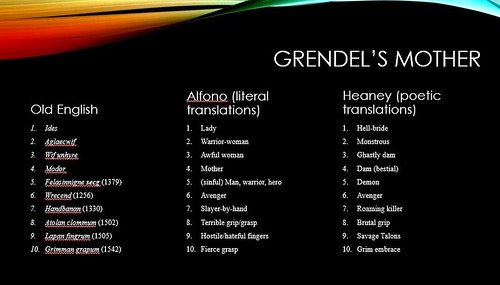
Grendels mother slide

Though I will agree to disagree with my students on our initial difference of understanding, the lecture served its purpose, and we had another lively discussion about why some translations may make sense, and how others belie the cultural prejudices named by Alfono in her own scholarship.


It's been an odd semester, engaged in two separate independent studies.  Left to my own devices for one, I found myself reading most of each week's novel before rushing off to the next at the rather frenzied pace I had set for myself.  Now I'm finding the time to get to the last few chapters of each as I prepare to write about them all. My reviews here are brief, because I am reserving more specific thoughts and readings for the essay I am preparing.

30.
Title: [Lady Audley's Secret]
Author: Elizabeth Braddon
Genre: Victorian Sensational FIction
Medium: Broadview Paperback
Acquisition: IS Primary Source
Date Completed: April 17, 2016
Rating: *****

Elizabeth Bradden's sensational 1862 novel was, according to the Broadview edition, "one of the most widely read novels in the Victorian period," and it's certainly clear why. Full of mystery, blackmail, bigamy, and other foul crimes, the text navigates social and gendered spheres with a rapidity that leaves the reader's head spinning with excitement as she follows the lay-about nephew of Sir Audley as he seeks out the truth of his friend's disappearance, and the secrets kept by his childish, doll-like aunt, Lady Audley.  The novel exchanges on the Victorian love of mystery and armchair detection, and offers a series of puzzles sure to delight original and contemporary readers.

The back of the Broadview edition further asserts that the novel "creates significant sympathy for the heroine, despite her criminal acts, as she suffers from the injustices of the 'marriage market' and rebels against them." My own reading contradicts this analysis, at least in the first. On the contrary, I found Lady Audley to be repugnant. Early in her life Lady Audley is treated very poorly, and her personal narrative seeks to emphasize the injustices of the gendered systems of nineteenth-century England. She is legitimately a victim a this point, and all sympathy belongs to her, blame falling squarely on the shoulders of he who mistreats her. However, her true character is revealed in how she seeks to improve her conditions, ultimately dissuading the reader from the sympathy Broadview suggests. There is a line of desperation and innocence Bradden could have maintained in order to shift blame and sympathy, but she crosses this.  The final explanations serve as a convenient and absurd excuse by a conniving criminal, and the triviality of her actions keep her from becoming even an engaging villain.  I am disappointed in Lady Audley, who I was very prepared to adore for her passionate grasping of autonomy and assertion of self, but I found her wanting.

As a whole, I thoroughly enjoyed the book, and found much to write about - so much, in fact, that my difficulty is now in limiting my options.


31.
Title: [North and South]
Author: Elizabeth Gaskell
Genre: Victorian FIction
Medium: Penguin Paperback
Acquisition: IS Primary Source
Date Completed: April 17, 2016
Rating: ***

For all my disappointment in Lady Audley, however, she remains far more engaging and interesting as a character than Margaret Hale, of Elizabeth Gaskell's 1855 North and South.  Upon the marriage of her cousin, Margaret Hale leaves the London house of her aunt, where she had been residing, to return to the utopia of her childhood home, of which she waxes eloquently to all who will hear for much of the early portions of the novel.  Unfortunately, this peace is broken by her father's crisis of conscience, and when he gives up his parish post he moves Margaret and her mother with him to a Northern industrial city, where they are forced to take dingy accommodations, breathe polluted air, and lament the lack of society in the city where Mr. Hale has elected to become a private tutor.  North and South ruminates on the deplorable living and working conditions of the lower-class employees of mills, as Margaret Hale tries to find her own place in Milton.  While the social commentary is thoughtful, and provides a useful perspective in understanding the use and function of the Victorian novel in the popular understanding of such divides and social reform, I could not maintain interest in the protagonist, who is ultimately too perfect to be compelling. I personally prefer characters with texture - or perhaps deviance -but even her transgressions are perfectly situated to emphasize her goodness and adherence to the expectations of proper nineteenth-century middle-class women.  Ultimately I was fairly horrified by the connotations of the conclusion of the romantic plot, which I assert promises only misery for Margaret.  

Sunday, April 14, 2013

29.
Title: [Beowulf]
Translator: Seamus Heaney
Pages:215
Genre: Anglo-Saxon Epic Poem
Medium: Paperback
Acquisition: Work Text
Date Completed: April 11, 2013
Rating: *****

Majestic, lyrical, thrilling and compelling: Beowulf is an enchanting epic poem of flawed heroism, broken social systems, gendered tyranny, shifting honor, and imperialistic Christianity.  Having read parts of the poem as a first-year undergraduate, I have long intended to read Heaney's best-selling translation.  For years it has waited on my shelf, until I decided to take the plunge and teach the text, the better to approach it analytically and while pressured into carefully reading the work in its entirety.  To do so proved to be greatly fulfilling, and I found myself weeping for the lost hero that I was cursing and judging a hundred pages before.  For perhaps obvious reasons, the question of Grendel's mother and the subject of wergeld proved to be of particular interest, and the definitions of heroes and monsters were inspiration for long classroom debates.  Pure joy. 

30. 
Title: [From the Mixed Up Files of Mrs. Basil E. Frankweiler]
Translator: E.L. Konigsburg
Pages: 176
Genre: Early Reader
Medium: Paperback
Acquisition: Library Book
Date Completed: April 14, 2013
Rating: ***1/2

Recently, this list of "67 Books Every Geek Should Read to their Kids" popped up through social media, and obviously caught my interest.  It is an interesting look at what adult "geeks" feel contributed to their own geekiness, and what they would hope to share with their own offspring.  The requirements for the list are bound only by submission, and some are a little more expected than others.  Many of the books are familiar, and I've turned to the library for many that are not.  The first of these is Frog and Toad are Friends, which the monsters and I enjoyed as a bedtime story recently.  The second is From the Mixed-Up Files of Mrs. Basil E. Frankweiler.

This book has obvious geek appeal: two children run away from home, and decide to hide away in a museum (where it's probably easier to hide than in a library, which would have been my first choice at age seven).  Determined to "learn one thing every day," the children set about visiting various exhibits, until they are caught by the mystery of a new acquisition - a statue that may or may not be an early work of Michelangelo.  If the museum itself didn't appeal, then surely the mystery does.  Determined not to return home until they mystery is solved - or, as Claudia more clearly relates, until she is different - the two search for clues in the library, the museum, and finally turned to the previous owner of the statue.

The story is charming, and the narrative is well-paced, which will hold a child's imagination without rushing them through.  A positive perspective on voluntary learning, and the passion one has for discovering the unknown, is certainly a lesson worth encouraging in children of all a

Wednesday, January 13, 2010

4.
Author: Daniel Hahn
Title: Poetic Lives: Coleridge
Publication: London: Hesperus Press, 2009..
Pages: 168 pages
Genre: Biography, poetry
Acquisition: December Library Thing Early Review
Date Completed: January 13, 2010
Rating: 4 stars out of 5

In a sentence, Poetic Lives is exactly what it claims to be - a "short, authoritative biograph{y} of {one of} the world's best known poets, illustrated by extracts from {his} work".

My initial reaction to Hahn's biography was not positive; the writing is terse and distant, and the juxtaposition of Hahn's biography and Coleridge's often amazing poetry did not seem flattering to the project as a whole. If asked to write a review based on the first thirty pages or so I would have said that it reads like a wikipedia article with none of the charm.

However, I took a step back from the work, read the back cover (from which I took the above quotation), and settled back in to read the book as it is intended. The "Poetic Lives" series does not claim to present in-depth and thoughtful biographies; rather, the goal seems to be to place a poet's work within the context of their lives so that an audience may better understand the work itself. And this is exactly what Poetic Lives: Coleridge accomplishes. Coleridge was inspired by life, and so looking at some of his work as part of his biography helps focus a reading of his poetry in the proper light. In this way this short volume is very interesting.

Poetic Lives: Coleridge is not an overly-scholarly publication, but I would imagine that it would be very helpful and enlightening for students, particularly undergraduates who are studying the Romantics for the first time. The lack of "scholarship" also opens the book to a wider audience, making it suitable for popular reading for anyone with a passing interest in Coleridge and his work.

Challenges
75-Book Challenge: Book 4
1010 Challenge: Poetry/Plays Book 1
Off-the-shelf:

Saturday, February 14, 2009

15. Poe, Edgar Allan. Complete Poems. 125 pages. 2.12.09.

16. McCarthy, Jenny. Belly Laughs. 165 pages. 2.14.09.


Jenny McCarthy's Belly Laughs is nothing short of adorable. I am currently expecting my second child, and picked up this book after hearing several positive reviews from other expectant mothers. McCarthy is straight-forward and honest about the joys and tribulations of pregnancies without ever losing her sense of humor. She makes several "taboo" subjects approachable, and in the face of so many books aimed at "scaring" pregnant women into doing things a certain way, McCarthy gives readers the bare facts while reassuring them that they can handle anything mother nature throws at them. Even if they don't agree with some of her choices, McCarthy's experiences will amuse and reassure her audience - especially those expecting their first baby.

17. De La Cruz, Melissa. Masquerade. 305 pages. 2.14.09.

18. Hamilton, Laurell K. A Lick of Frost. 342 pages. 2.14.09.

Friday, January 16, 2009

The first 5 of 2009

1. Robinson, Ray (ed). Famous Last Words: Fond Farewells, Deathbed Diatribes, and Exclamations Upon Expiration. 177 pages. 1.2.09
A very disappointing collection

2. Bronte, Charlotte. Jane Eyre: The Graphic Novel. 132 pages. 1.10.09
While an interesting idea, this volume is barely a shadow of the original text, and has none of its charm. The text itself is so badly butchered that it leaves me wondering if someone unfamiliar with the original novel would even be able to follow the story itself. I can appreciate it only as a novelty item, but would never recommend it to someone who has not read Bronte's novel. It would be useful in a classroom setting only as a supplemental text, and could never replace the original.

3. Miller, Kathleen E. Last Laughs: Funny Tombstone Quotes and Famous Last Words. 157 pages. 1.12.09

4. Carson, Anne (ed). If Not, Winter: Fragments of Sappho. 355 pages. 1.13.09
This collection of fragments is simply majestic. While I can't help feeling a loss for what didn't survive, Carson's presentation is rich with possibilities.

5. Hamilton, Laurell K. A Stroke of Midnight. 385 pages. 1.16.09